The short answer
Use blackout fabric, then close the gaps around it, because that is where your light gets in. Hang a curtain rod 4 to 6 inches above the frame and run it 6 to 12 inches past each side. Buy fabric 2 to 2.5 times the rod width so the panels overlap (Curtarra, 2025). An inside-mounted shade leaves a thin gap at each side, so mount it outside the frame or in side channels. A bright room or a day sleeper usually needs a shade and a curtain together.
This guide is for: anyone whose bedroom faces a streetlight, an early sunrise, or a work schedule that means bedtime while it is still light outside.
Key Takeaways
- One night under 100 lux raised nighttime heart rate and next-morning insulin resistance in 20 young adults, against a night under 3 lux (Healio, 2022).
- The average person's melatonin was halved at 24.60 lux in a lab study of 55 adults. The most sensitive reacted at 6 lux (Phillips et al., 2019).
- We read 24 seller pages in September 2026, 14 for curtains and 10 for shades. Most rated the cloth alone, and 6 of the 10 shade pages warned that light gets past the edges.
How dark does a bedroom need to be for sleep?
Darker than most people picture. One night at 100 lux raised heart rate, and the average person's melatonin was halved at about 25 lux.
The dose of light that changes the body overnight is far smaller than most people picture as darkness. In a Northwestern laboratory study, 20 young adults slept two nights under set lighting (PNAS via PMC, 2022). One group had a night under 3 lux, then a night under ordinary room light at 100 lux. That single lit night raised nighttime heart rate and next-morning insulin resistance (Healio, 2022). The room never looked bright.
Evening light works on an even lower threshold. A study of 55 adults aged 18 to 30 found the average person's melatonin was cut in half at 24.60 lux. People hit that point anywhere from 6 to 350 lux, a more than 50-fold spread. Light at 10, 30 and 50 lux delayed melatonin onset by 22, 77 and 109 minutes (Phillips et al., 2019). That spread is why you may sleep through a streetlight that keeps your housemate awake. Even at 1 lux all night, 33 volunteers showed no drop in melatonin metabolites, yet their sleep broke up more often (IJERPH, 2020).
| Room light level | What the published work reports | Source |
|---|---|---|
| 1 lux all night | More sleep fragmentation, melatonin unchanged | IJERPH, 2020 |
| Under 10 lux | Used as the dim-light threshold in studies | PMC, 2021 |
| 24.60 lux | Melatonin halved in the average adult | Phillips et al., 2019 |
| 100 lux | Higher heart rate, higher morning insulin resistance | Healio, 2022 |
In practice, any light bright enough for you to make out the furniture is worth blocking.
What do blackout labels and seller pages promise?
A blackout percentage rates a swatch of cloth on a test rig. Two test methods define blackout differently, so treat any figure as a ceiling.
The published percentage rates the cloth and says nothing about the bedroom. Two test methods, Japan's JIS L 1055 and the American AATCC TM203, define light blocking in different ways. A fabric rated 99.99% blackout under one can be rejected as translucent under the other (Begoodtex, 2025). Construction says more than the swatch. A single-layer panel at 200 g/m² will never block all light, while a multi-layer panel at 500 g/m² or more blocks it in any color (Kurtens, 2026).
We read 14 curtain pages on 20 and 21 September 2026 and 10 shade pages on 26 September 2026. We counted what each one states about blocking light.
| Pages | What the page states | Count |
|---|---|---|
| Curtains, 14 | A percentage or band, from 70 to 100 percent | 6 |
| Curtains, 14 | Words with no number, such as "blocks out all light" | 6 |
| Curtains, 14 | Lux estimates instead of a percentage | 2 |
| Shades, 10 | Total darkness only (100%, "all" or "complete") | 4 |
| Shades, 10 | A figure below 100% only (99% to 99.9%) | 3 |
| Shades, 10 | Both total darkness and a lower figure | 3 |
The curtain guides disagree on where room darkening ends. One puts true blackout at 90 to 100 percent (uscurtains), which still leaves a sleeper guessing how dark the finished window will be. The two lux pages state that their figures are converted from maker percentages rather than measured (UBlockout, 2026). Six of the 10 shade pages said somewhere that light can get past the edges or over the top. Those warnings describe the room rather than the fabric.
Where does light still get in around curtains and shades?
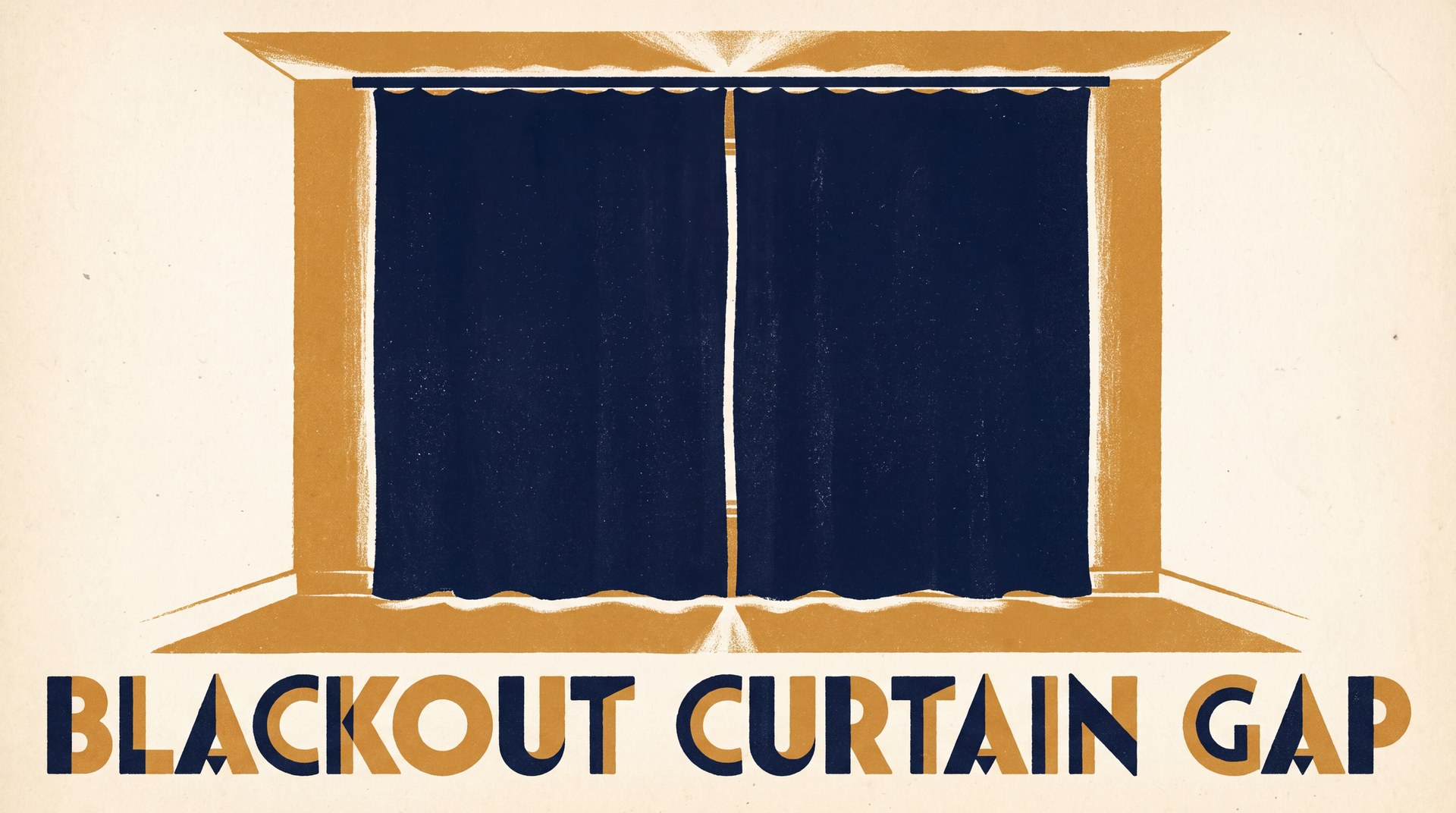
Light arrives around the cloth rather than through it: over a curtain rod, beside a shade, at the center split, under the hem.
The cloth is rarely the failure point. A standard curtain rod leaves four open paths before the weave matters. An inside-mounted shade has its own. It must be narrower than the opening to move, and one blinds retailer says standard blackout shades leave a ⅛ to ½ inch gap for clearance (Canisteo Blinds). Roller shades add a sliver at the top, where the fabric wraps around its tube (Factory Direct Blinds). Half an inch sounds trivial until it runs the full height of the window. From your pillow, those strips can be the brightest things in the room.
The table is our own ranking for a typical bedroom window, built from the sources in this guide. It rests on judgement, because this publication owns no instruments.
| Leak path | Our rank | The fix we would try first |
|---|---|---|
| Above a curtain rod or shade roll | 1 | Ceiling track, cornice board or cassette valance |
| Side of a panel or shade | 2 | Wraparound rod, outside mount or side channels |
| Center split between panels | 3 | Enough width that the panels overlap |
| Floor or sill | 4 | Panels to the floor; shade mounted past the sill |
| Through the cloth | 5 | A multi-layer panel or a blackout lining |
Test the last row first by holding your cloth against a strong light. A technical multi-layer panel lets nothing through, even with a flashlight pressed against it (Kurtens, 2026). If the cloth passes and your room still glows, the light is coming around it.
How should blackout curtains be hung so they work?
Mount high, run the rod 6 to 12 inches past each side, buy 2 to 2.5 times the rod width in fabric, and close the center overlap.
Trade guidance and energy-saving advice point the same way, so the installation recipe is short. Set the rod at least 4 to 6 inches above the frame, and extend it 6 to 12 inches past the frame on each side. Then buy total fabric width of 2 to 2.5 times the rod width (Curtarra, 2025). Width buys you the overlap, and the overlap closes the center seam.
The sealing steps come from energy advice written for heat, and they work just as well for light. Hang the curtains as close to the window as possible, and install a cornice at the top. Then seal the panels at the sides, and overlap them in the middle (Consumer Reports, 2023). The same guidance names hook-and-loop tape or plain tape for that sealing and overlapping work.
Allow extra rod at each end for bulk. Large grommets, thick blackout lining and deep pinch pleats all make a wider stack when the panel is open (Homestyle Calculator, 2026). A hem touching the floor closes the fourth path, and a track fixed to the ceiling closes the first one. Generous hardware makes the same fabric perform better. In our judgement, a mid-range panel hung high and wide leaves a room darker than the densest panel hung inside the frame.
Should a blackout shade go inside or outside the window frame?
Outside, if darkness is the goal. A shade that overlaps the frame by 2 to 3 inches per side covers the gaps an inside mount leaves open.
An inside mount looks tidy and shows off the window trim, but it guarantees the side gaps described above. An outside mount fixes the shade to the wall or trim above the window and makes it wider than the opening. One seller's measuring guide recommends adding 4 to 6 inches to the width, or 2 to 3 inches on each side, to reduce light leakage (TWOPAGES). The same guide suggests mounting the shade 10 to 12 inches above the frame where space allows. The rolled-up shade then sits on the wall and not over the glass.
Measure the width at the top, middle and bottom of the trim, and use your largest number, because windows are rarely square (SenseBlinds). An outside-mount shade is made to the exact size you order, so the overlap has to be in the width you enter (Beyond Shades).
Some shades cannot be trimmed. IKEA says its TRETUR blind can't be cut and supplies a cover panel so it can still block light when mounted inside the frame (IKEA). The FÖNSTERBLAD blind can be cut to width at home (IKEA). Add-on side channels are sold for shades already hanging in the window. You can seal an inside mount later without replacing it (Sleepy Time Tracks).
How do roller, cellular and slatted shades differ at the edges?
A cellular or roller shade in side channels leaves the least light at the edges. Slatted blinds leak most, because light passes between slats.
The grades below are our judgement. We built them from the gap sizes and edge warnings that sellers publish, and nothing was measured here. They compare setups rather than products and assume blackout-backed fabric throughout, because in a bedroom fit decides more than fabric. A third seller says that even with fabric that blocks 99% of light, buyers can expect leakage along all 4 edges of an inside-mounted roller (EcoSmart Shades).
| Setup | Main leak | Our grade for a bedroom |
|---|---|---|
| Slatted blinds, including faux wood | Between slats and through cord holes | Dim at best; not a blackout setup |
| Roller shade, inside mount | Both sides and over the roll | Dark center, bright edges |
| Cellular shade, inside mount | Narrow gaps at both sides | Close to an inside roller |
| Lined Roman shade, outside mount | Sides, if overlap is small | Good with generous overlap |
| Roller or cellular, outside mount with overlap | Small leaks at sides and top | Dark enough for most night sleepers |
| Roller or cellular in side channels | Little left at the edges | Darkest shade-only setup |
Blinds are the weakest for sleep. Slats tilted shut still leave a line of light at every joint, and the cord opening adds one more. If you sleep by day, in our judgement a single layer rarely handles direct sun on a bright window, which is where the next section comes in.
How do a shade and a curtain work together on one window?
A shade seals the glass and a curtain covers the wall around it, so layering one over the other closes each one's weak point.
The two fail in different places. A shade sits close to the glass and stops light before it spreads. Shades work best mounted as close to the glass as possible, which creates a sealed space (Consumer Reports, 2023). Its weakness is the edge channel. A curtain hung wide and high overlaps the wall by several inches. Near the ceiling it beats a shade at the top edge, though light can spill over the rod and under the hem.
Layering is the usual answer for a bright bedroom: a shade for the glass, and a wide panel outside it for the surrounding wall. Retailers sell the same pairing as a styling choice. They put sheer curtains with blackout panels so a room can switch between daylight and privacy (IKEA curtains). If you rent and cannot drill side channels into a frame, a curtain over the shade is also the simplest fix.
| Question | Blackout shade | Blackout curtain |
|---|---|---|
| Where it seals | At the glass | Around the window, on the wall |
| Typical leak | Sides and top of the shade | Over the rod and under the hem |
| Good alone for | A dark room at night | A room where the frame can't be drilled |
| Paired with the other | Catches light at the glass | Catches what escapes the shade's edges |
Night-shift workers sleep through the brightest hours, so they need both layers from the start.
Do blackout curtains and shades make a bedroom cooler or quieter?
Closed drapes can cut summer heat gain by about a third, and snug cellular shades cut window heat loss in winter. On noise, they do little.
The thermal case is genuine and modest. Studies have found that medium-colored draperies with white plastic backings can reduce heat gain by 33 percent, depending on fabric type and color (Consumer Reports, 2023). If you close a lined panel on a sunny window before the sun reaches the glass, your bedroom stays cooler by bedtime. Cellular shades trap air in their honeycomb pockets. A seller summarizing Department of Energy guidance reports that tightly installed cellular shades can cut heat loss through windows by 40% or more in heating seasons (Blindster).
One caution comes with the insulation. A DOE-backed resource warns that interior insulating shades can let condensation or frost form on the glass in winter. That can lead to peeling paint and mold (Building America Solution Center). If your glass fogs behind a closed shade, raise it for part of the day.
Noise is where the marketing outruns the physics. Fabric soaks up sound bouncing around inside a room, but stopping sound from entering takes mass and a sealed edge. An acoustics supplier puts the realistic reduction from even heavy, well-sealed curtains at 1 to 5 decibels (Second Skin Audio, 2025). If traffic wakes you, masking sound is the cheaper tool, and our guide on white noise for sleep covers how to set it up.
What do the cord rules mean for shades in a child's room?
Stock shades sold in the US must be cordless or keep cords out of reach, and since June 2024 custom shades have dropped free-hanging cords too.
Window covering cords are a strangulation risk for young children, and US rules have tightened around them. Since December 28, 2022, the Consumer Product Safety Commission has treated stock window coverings with hazardous operating cords as a substantial product hazard (Federal Register, 2022). A 2022 summary of the stock requirements says operating cords must be cordless, inaccessible, or eight inches or shorter in any position (SBA Office of Advocacy).
Custom shades have become safer for a sleeping child as well, because a made-to-order shade no longer comes with a loose cord. The industry standard ANSI/WCMA A100.1-2022, in effect since June 1, 2024, removed free-hanging operating cords from made-to-order products (Window Covering Safety Council). The rules are still changing. On September 24, 2026, the CPSC proposed further amendments and will take written comments until November 23, 2026 (Federal Register, 2026).
For a parent, the agency's own review is reassuring: its staff put overall compliance among the products they reviewed at about 91 percent (Federal Register, 2026). Most shades on sale meet the rules, but a quick check is still worth doing before one goes up near a sleeping child. In your child's room, a cordless lift, a wand or a motor avoids the question. Check that no cord or bead chain hangs within reach of the bed or crib. Older shades already in the house need the same check.
Common questions
Short answers to the questions people ask once the window is covered, from children's rooms and rentals to night shifts and washing.
Do blackout curtains block 100 percent of light?
No. Blackout fabric blocks 99 to 100 percent of light through the cloth, but that figure covers the fabric only. Light still gets in through gaps at the top, sides and bottom (Allure Window Treatments, 2026). A wider, higher rod closes most of them, so the room stays dark until the sleeper means to wake.
How light-sensitive are children at bedtime?
Children look at least as light-sensitive as adults. In preschool-aged children, melatonin fell an average of 78 percent in response to light measured at 5 to 40 lux. In most of them it had not rebounded 50 minutes after the light went off (University of Colorado Boulder, 2022).
Can I add blackout to curtains I already like?
Yes, and a separate lining is often the cheaper route, since a blackout liner behind an existing panel adds layers and mass. Then seal the sides and overlap the panels in the middle, with a cornice at the top (Consumer Reports, 2023).
What works for renters who cannot drill?
Some roller shades install without drilling. One listing describes a trim-to-fit shade that goes up with no screws or brackets (LazBlinds). Hang a curtain over it to cover your edges.
What should night-shift workers do?
Plan for two layers from the start: a shade in side channels or mounted outside the frame, with a blackout curtain over it. Even one night of sleep under 100 lux raised heart rate in a lab study (Mason et al., 2022).
How do I wash a blackout curtain without ruining it?
Follow the panel's own label, since woven and coated panels differ. IKEA's ROSENMANDEL page states maximum 4 percent shrinkage and cold machine wash on a normal cycle, and rules out tumble drying (IKEA ROSENMANDEL). Coated panels are the ones that crack and shed if you fold them hard.
The room check sends answers like these to light reaches the bed before you mean to wake, and a check at dawn will show where.
Sources
Night Air's reading for this piece, in the order it is cited, each with the question it helped answer.
- Curtarra, 2025 (curtarra.com), helped answer “How should blackout curtains be hung so they work?”.
- Healio, 2022 (healio.com), helped answer “Key Takeaways”; “How dark does a bedroom need to be for sleep?”.
- Phillips et al., 2019 (pmc.ncbi.nlm.nih.gov), helped answer “Key Takeaways”; “How dark does a bedroom need to be for sleep?”.
- PNAS via PMC, 2022 (pmc.ncbi.nlm.nih.gov), helped answer “How dark does a bedroom need to be for sleep?”.
- IJERPH, 2020 (pmc.ncbi.nlm.nih.gov), helped answer “How dark does a bedroom need to be for sleep?”.
- PMC, 2021 (pmc.ncbi.nlm.nih.gov), helped answer “How dark does a bedroom need to be for sleep?”.
- Begoodtex, 2025 (begoodtex.com), helped answer “What do blackout labels and seller pages promise?”.
- Kurtens, 2026 (kurtens.com), helped answer “What do blackout labels and seller pages promise?”; “Where does light still get in around curtains and shades?”.
- uscurtains (uscurtains.com), helped answer “What do blackout labels and seller pages promise?”.
- UBlockout, 2026 (ublockout.com), helped answer “What do blackout labels and seller pages promise?”.
- Canisteo Blinds (canisteoblinds.com), helped answer “Where does light still get in around curtains and shades?”.
- Factory Direct Blinds (factorydirectblinds.com), helped answer “Where does light still get in around curtains and shades?”.
- Consumer Reports, 2023 (consumerreports.org), helped answer “How should blackout curtains be hung so they work?”; “How do a shade and a curtain work together on one window?”; “Do blackout curtains and shades make a bedroom cooler or quieter?”; “Common questions”.
- Homestyle Calculator, 2026 (homestylecalculator.com), helped answer “How should blackout curtains be hung so they work?”.
- TWOPAGES (twopagescurtains.com), helped answer “Should a blackout shade go inside or outside the window frame?”.
- SenseBlinds (senseblinds.com), helped answer “Should a blackout shade go inside or outside the window frame?”.
- Beyond Shades (bshades.com), helped answer “Should a blackout shade go inside or outside the window frame?”.
- IKEA (ikea.com), helped answer “Should a blackout shade go inside or outside the window frame?”.
- IKEA (ikea.com), helped answer “Should a blackout shade go inside or outside the window frame?”.
- Sleepy Time Tracks (sleepytimetracks.com), helped answer “Should a blackout shade go inside or outside the window frame?”.
- EcoSmart Shades (ecosmartshades.com), helped answer “How do roller, cellular and slatted shades differ at the edges?”.
- IKEA curtains (ikea.com), helped answer “How do a shade and a curtain work together on one window?”.
- Blindster (blindster.com), helped answer “Do blackout curtains and shades make a bedroom cooler or quieter?”.
- Building America Solution Center (basc.pnnl.gov), helped answer “Do blackout curtains and shades make a bedroom cooler or quieter?”.
- Second Skin Audio, 2025 (secondskinaudio.com), helped answer “Do blackout curtains and shades make a bedroom cooler or quieter?”.
- Federal Register, 2022 (federalregister.gov), helped answer “What do the cord rules mean for shades in a child's room?”.
- SBA Office of Advocacy (advocacy.sba.gov), helped answer “What do the cord rules mean for shades in a child's room?”.
- Window Covering Safety Council (windowcoverings.org), helped answer “What do the cord rules mean for shades in a child's room?”.
- Federal Register, 2026 (federalregister.gov), helped answer “What do the cord rules mean for shades in a child's room?”.
- Allure Window Treatments, 2026 (allurewindowtreatments.com), helped answer “Common questions”.
- University of Colorado Boulder, 2022 (colorado.edu), helped answer “Common questions”.
- LazBlinds (amazon.com), helped answer “Common questions”.
- Mason et al., 2022 (pubmed.ncbi.nlm.nih.gov), helped answer “Common questions”.
- IKEA ROSENMANDEL (ikea.com), helped answer “Common questions”.