The short answer
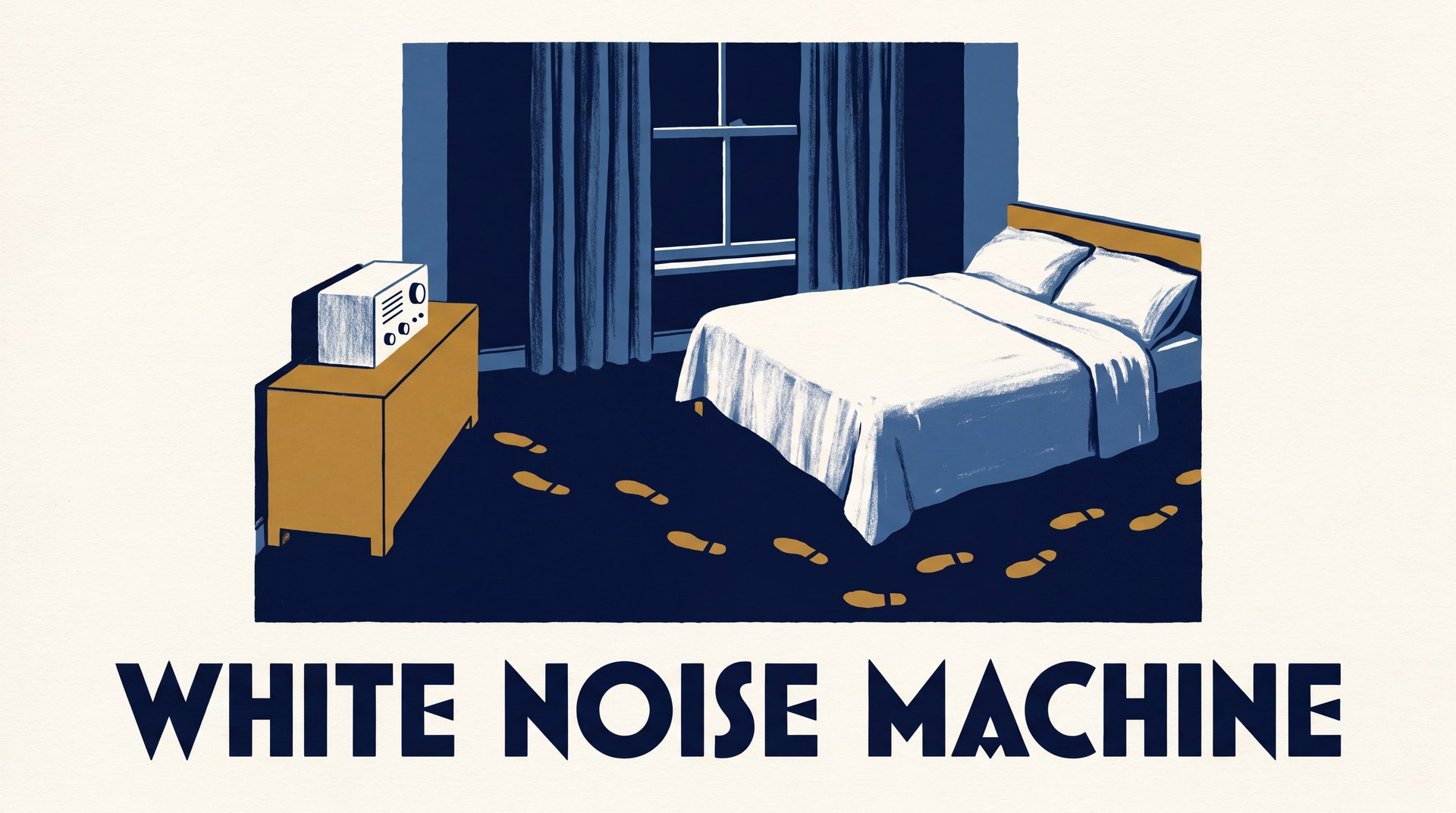
White noise works by masking: steady broadband sound raises the room's background level, so the peaks that cause awakenings stand out less. In one lab study, arousals stayed near baseline when white noise was added to recorded hospital noise, and a crossover trial found 38% faster sleep onset at 46 dB. Across 38 studies the graded quality of evidence is low, and a 2026 lab trial found that pink noise cut dream sleep while earplugs worked better. Treat it as a cheap fix for a noise problem, at the lowest level that works, not a cure for insomnia.
This guide is for: anyone deciding whether to run steady sound in the bedroom tonight, at what volume, and from what device.
Key Takeaways
Three numbers worth carrying away: what one trial cut, what the evidence grade is, and the decibel ceiling used in hospital nurseries.
- Masking is the mechanism. In a small polysomnography study, the arousal index rose from 13.3 per hour at baseline to 48.4 under recorded intensive care noise, but it sat at 15.7 when white noise was added to that same recording (Sleep Medicine, 2005).
- The speed gain is real but modest. Eighteen healthy adults reached stable stage N2 sleep in a median 13 minutes with broadband sound at 46.0 dB, while the control night took 19 minutes, a 38% reduction (Frontiers in Neurology, 2017).
- Volume is the safety question. All 14 infant sleep machines tested at maximum volume passed 50 dBA at 30 cm, the nursery limit, and three of them passed 85 dBA (ENTtoday, 2014).
Does white noise help you sleep, or does it mask what would wake you?
Steady sound does not sedate anyone; it raises the floor of the room, so sudden peaks stand out less and wake the sleeper less often.
The clearest finding here is about contrast, not loudness, and the design of the study shows why. Sleepers were recorded across three nights: a baseline night, a night of recorded intensive care noise, and a night with that same recording plus mixed-frequency white noise. Against 13.3 arousals an hour at baseline, the index rose to 48.4 under the noise recording, and it settled back to 15.7 once white noise was added. What decided an arousal was the jump from background to peak, not the peak level itself, at 17.7 against 17.5 dB (Sleep Medicine, 2005).
Read that as an instruction rather than a result, because the brain reacts to the jump. A door closing two rooms away is disruptive in a silent bedroom, while in a room that already carries a steady floor of sound, the same door is hardly noticed. Masking does nothing if your real problem is a hot room or a late coffee, and our guide to what temperature a bedroom should be for sleep covers the first of those. The sample was tiny, and the team was modelling a hospital ward rather than a flat above a main road. The principle still travels, because the physics of contrast does not change with the address.
How strong is the evidence that white noise improves sleep?
A review of 38 studies rated the evidence low; one small trial found faster sleep, and a 2026 trial found pink noise cut dream sleep.
A 2021 systematic review identified 38 studies of broadband noise used as a sleep aid. It found inconsistent methods, small samples and mostly subjective outcomes, and graded the evidence low. A more recent review found that 56% of studies reported positive effects, again resting on largely low-quality evidence (SLEEP, 2026).
Individual trials look better than the pooled picture. Eighteen healthy adults slept two nights a week apart, hearing in random order either normal room noise at 40.1 dB or broadband sound at 46.0 dB from two speakers, and latency to stage N2 fell from a median of 19 minutes to 13 (Frontiers in Neurology, 2017). That was one night per condition, in healthy sleepers.
The newest trial points the other way. In a seven-night sleep-lab study of 25 healthy adults, played at 40 or 50 dBA, pink noise on its own cut REM sleep, the dream stage, and adding it to traffic-style noise worsened sleep structure overall. Foam earplugs, by contrast, blocked nearly all the effects of the traffic noise (SLEEP, 2026). The accompanying editorial adds that long-term safety evidence is missing, especially for infants.
The honest summary is that the effect is small, uncertain, and may cost some dream sleep. If earplugs suit you, try them first. If they do not, the sensible test is a week of sound at the lowest level that works, which the final section of this guide sets out step by step.
What is the difference between white, pink, and brown noise for sleep?
The colors differ by spectral slope: flat for white, down about 3 dB an octave for pink, and about 6 dB an octave for brown noise.
The names describe spectra, not quality. Pink noise has a spectral power density that decreases by 3.01 dB per octave compared with white noise, while Brownian noise, also called brown noise, decreases by 6.02 dB per octave (Wikipedia, Colors of noise). White noise carries equal power in every one-hertz band, and most of that energy lands in the octaves the ear finds bright, so it sounds like radio static. Brown noise pushes the same energy downward, and reads to most listeners as a low rumble.
Sellers often call all three "white noise" on a product page, and one file may be labelled three different ways by three different shops. What matters for masking is whether the spectrum overlaps the sound you are covering.
| Color | Slope against white | How it reads | What it suits, our judgement |
|---|---|---|---|
| White | 0 dB per octave | Bright hiss | Speech, clicks, keyboards, television chatter |
| Pink | Down about 3 dB per octave | Steady rainfall | General street and household noise |
| Brown | Down about 6 dB per octave | Deep rumble | Bass through walls, lorries, plant machinery |
Slope figures come from the source above. The suitability column is our judgement rather than a measurement.
How loud should white noise for sleep be?
Aim just above the sound being covered, since the trial that cut sleep onset ran 46 dB in the room, six above its quiet control night.
Two published anchors bracket a sensible range for you. WHO community noise guidance recommends less than 30 dB(A) in bedrooms at night for good sleep (WHO), while the crossover trial above ran its speakers at 46.0 dB (Frontiers in Neurology, 2017). Set the level just high enough that the unwanted sound stops standing out, then stop turning it up.
We read 11 published pages on white noise and sleep on 20 September 2026, sorting each one by what it states about level. Four report the decibel level of the noise used in a trial or in a product test. Three are agency or journal pages that state a decibel limit rather than a trial setting, and the remaining four describe a white noise intervention with no decibel figure anywhere in the text we read. We counted what those pages state, since we hold no instruments and tested nothing here.
| Reference point | Stated level | Source |
|---|---|---|
| Bedroom at night, WHO community guidance | under 30 dB(A) | WHO |
| Outside bedrooms, WHO night noise target | under 40 dB(A) Lnight | WHO |
| Room level in the transient insomnia trial | 46.0 dB, against 40.1 dB control | Frontiers in Neurology, 2017 |
| Nursery limit cited in the infant machine study | 50 dBA | ENTtoday, 2014 |
| Workplace exposure NIOSH recommends staying below | 85 dBA over eight hours | OSHA |
Where should a white noise machine sit in the bedroom?
Distance buys headroom, because sound fades as it travels, so a unit across the room can cover a street without sitting close to a head.
Placement is the least expensive control in the room. In the infant machine study, levels were taken at 30 cm and again at 200 cm, and even at the far distance all but one device still passed 50 dBA (ENTtoday, 2014). So move the source away from your pillow, and toward the noise you want covered.
Put the machine between the bed and the sound being covered. In most flats that means near the window or against the party wall. The outside noise has to cross that gap first, and the arrangement avoids building a second loud zone beside a sleeping ear. Skip the headboard and the bedside table wherever the room allows, because those spots force a low setting, and a low setting close to your head masks less of the room than a moderate setting across it. Hard surfaces bounce brightness back, so a unit on a bookshelf tends to sound harsher than the same unit on a fabric-topped dresser. One machine is usually enough for a single bedroom.
Is free white noise for sleep as good as a white noise machine?
Free files cost nothing and carry two risks: short loops that draw attention, and phones that break the sound with notifications.
A generated sound and a recorded loop are not the same product. A short loop with an audible seam gives the ear a repeating event to notice, which is the opposite of what masking needs. Streaming adds a second failure mode, because a dropout partway through the night returns the room to silence, just when the contrast matters most. None of that makes free files useless: a long generated file, played from a laptop on a shelf, can cover a street as well as a machine does.
Phones bring their own problems: alerts, screen light, and a charging cable that pulls the source toward the pillow. If a phone is the source anyway, download the file, switch on airplane mode, and leave the handset face down well away from your bed. A dedicated unit earns its money through convenience, and through a volume dial you can set once and then leave alone.
| Bedroom noise problem | Suits masking, our rating out of 5 | Reasoning |
|---|---|---|
| Intermittent street traffic | 5 | Peaks are short and masking closes the gap |
| Housemates awake later than you | 4 | Speech and doors are classic contrast events |
| Snoring partner | 3 | Low in pitch and close by, so partial cover at best |
| Bass through a shared wall | 2 | Needs mass and sealing, not more sound |
| Tinnitus | 2 | Response varies widely and can go either way |
| Already quiet room, under 30 dB | 1 | Nothing to mask, and exposure rises for no gain |
Ratings are our judgement from the studies cited on this page, and no maker publishes this table.
Is white noise safe for babies and for adult hearing?
Safety is a volume question rather than a sound question, since measured output of 14 infant machines ran past nursery limits at close range.
The strongest caution in this field came from a product test, not a sleep study. Researchers tested 14 infant sleep machines at maximum volume, and at 30 cm all 14 passed 50 dBA, with three of them producing more than 85 dBA. At 200 cm, all but one still passed 50 dBA (ENTtoday, 2014).
That 85 figure is the same one used at work. NIOSH recommends that worker exposure stay below a level equivalent to 85 dBA over eight hours, and under 15 minutes a day at 100 dBA (OSHA). No bedroom should run near those levels. Keep the machine off the cot rail, keep it across the room, and keep the dial well below maximum. The practical rule follows from the test itself: distance and a modest setting do more for safety than any choice of sound. If you can hear the machine clearly from the doorway, it is already loud enough for the room.
Who should skip white noise for sleep?
Light sleepers who wake to the sound itself, people whose tinnitus flares with masking, and anyone whose bedroom is already quiet.
Not every sleeper gains from it: the 2021 review found inconsistent methods and mostly subjective outcomes across 38 studies, while a later review reported positive effects in 56% of studies, on largely low-quality evidence (SLEEP, 2026). A rate near half is fair warning that response varies a great deal between people. If your room already meets the 30 dB(A) bedroom figure in WHO guidance (WHO), added sound brings exposure without a problem to solve.
Three groups should be cautious. People with tinnitus sometimes find masking helpful, and sometimes find that it sharpens the ringing, so a daylight trial beats a whole night. A shared bed needs a level both sleepers accept, because the person who dislikes the sound loses more sleep than the other one gains, and earplugs may suit that household better. Babies need distance and a low setting rather than a machine parked on the cot. Stop if it becomes the sound you wake up listening to.
How do you test white noise for sleep in your own bedroom?
Give it a week and change one thing at a time, judging it on night wakings rather than on how the sound feels in the first ten minutes.
Run a seven-night trial with one variable and nothing else moving, keeping the same file, the same placement, and the same volume all week. Log how many wakings you remember, and roughly how long you lay awake each night. Sleep onset is a poor test on its own, because a new sound is interesting on night one and boring by night four.
If the week is no better, change one thing before you give up on the idea. Move the unit closer to the window, drop the setting a notch, or switch from white to brown for low-pitched noise from a neighbour. The trial that found a 38% latency reduction used only a 6 dB difference between its two conditions (Frontiers in Neurology, 2017), so small changes are worth taking seriously. Rule out the less expensive fixes first, since a sealed window gap or a heavier curtain removes the noise instead of covering it, and our guide to choosing blackout curtains for a bedroom covers the heavy-curtain part of that. Keep whatever survives the week, and drop the rest.
Common questions
Six quick answers on timers, partners, babies, earplugs, brown noise, and whether a phone app can do the job of a dedicated unit.
Should the sound run all night or stop on a timer?
Run it all night if the noise being masked is intermittent, such as traffic or neighbours. A timer that cuts out halfway through the night returns the room to silence, which is the moment a peak can wake a sleeper, and it undoes the contrast benefit described above.
Does white noise work if my partner dislikes it?
Set the level to whatever the more sensitive sleeper accepts, then improve the placement rather than the volume. Moving the unit to the window wall often covers the same street noise at a lower setting, which is usually enough to end the argument.
Is brown noise better than white noise for sleep?
Neither one is better in general. Brown noise falls about 6 dB per octave and carries more low-frequency energy, so it suits rumble and bass, while white noise has more high-frequency content and suits speech and clicks.
Can I use earplugs instead?
Often, yes. Earplugs remove the noise rather than covering it, and in the 2026 sleep-lab trial they blocked nearly all the effects of traffic noise where pink noise did not (SLEEP, 2026). Some people cannot tolerate them, and they mute alarms and a child's cry, so your choice depends on what has to be heard.
Is a phone app enough, or do I need a machine?
An app is enough if the file is downloaded, notifications are silenced, and the handset sits well away from the head. A dedicated unit mainly buys a stable volume setting, and a source that nobody is tempted to pick up in the night.
Will my child become dependent on it?
Any consistent cue becomes part of the sleep routine, including a dark room and a bedtime story. If that worries you, keep the level low and the machine far from the cot. The 2014 product test found that even at 200 cm most machines at full volume still passed the nursery limit, so the dial matters as much as the distance.
The room check sends answers like these to noise is waking you, and a sound reading at night will show when.
Sources
Night Air's reading for this piece, in the order it is cited, each with the question it helped answer.
- Sleep Medicine, 2005 (utsouthwestern.elsevierpure.com), helped answer “Key Takeaways”; “Does white noise help you sleep, or does it mask what would wake you?”.
- Frontiers in Neurology, 2017 (ncbi.nlm.nih.gov), helped answer “Key Takeaways”; “How strong is the evidence that white noise improves sleep?”; “How loud should white noise for sleep be?”; “How do you test white noise for sleep in your own bedroom?”.
- ENTtoday, 2014 (enttoday.org), helped answer “Key Takeaways”; “How loud should white noise for sleep be?”; “Where should a white noise machine sit in the bedroom?”; “Is white noise safe for babies and for adult hearing?”.
- SLEEP, 2026 (pmc.ncbi.nlm.nih.gov), helped answer “How strong is the evidence that white noise improves sleep?”; “Who should skip white noise for sleep?”; “Common questions”.
- Wikipedia, Colors of noise (en.wikipedia.org), helped answer “What is the difference between white, pink, and brown noise for sleep?”.
- WHO (who.int), helped answer “How loud should white noise for sleep be?”; “Who should skip white noise for sleep?”.
- OSHA (osha.gov), helped answer “How loud should white noise for sleep be?”; “Is white noise safe for babies and for adult hearing?”.