The short answer
The body's core temperature falls after bedtime and climbs again before waking (study of younger and older women). It gets rid of that heat through warm hands and feet. A cool room keeps the dip running, while humid heat cuts deep and dream sleep even under ordinary covers (Okamoto-Mizuno and Mizuno, 2012). Most US health pages give 60 to 67°F (Cleveland Clinic), though older adults slept most restfully at 68 to 77°F (Hebrew SeniorLife).
This guide is for: anyone who wakes up hot, argues over the thermostat, or wants to know what the body does with heat at night.
Key Takeaways
Three findings carry most of this guide: which way core heat moves at night, how the published room range fits the dip, and what a warm bath does.
- Your core cools at night while the skin of your hands and feet warms. Hands and feet warm by about 1°C as you fall asleep (smart bed skin temperature study). In lab work, that hand-and-foot warming predicted how quickly people fell asleep better than core temperature did (Kräuchi et al., 2000).
- Most published pages give the room 60 to 67°F. Of the 12 health and sleep pages we read on September 26, 2026, 8 give exactly that range. Even so, home data on older adults found the most restful sleep between 68 and 77°F (Hebrew SeniorLife).
- Warm up before bed so you cool down in it. A pooled review found that bathing 1 to 2 hours before bed in water of about 104 to 109°F improved sleep. Bathers fell asleep about 10 minutes sooner on average (UT Austin).
The first two sections explain what the body does with heat at night. The third shows how the room's air sets the pace of that cooling, and the fourth checks the common advice against a dozen published pages. The last four follow the room and the bed through the night, from cold rooms to baths and fans. Every figure links to the page it came from, so each number can be checked against its source.
Which way does the body's temperature move through the night?
Your core temperature goes down through the night and bottoms out before waking. The skin on your hands and feet warms up.
Body heat follows a daily rhythm set by the brain's internal clock. Core temperature peaks in the early evening, falls further after bedtime and begins to rise again before you wake (study of younger and older women). Heat lost through the hands and feet shapes that rhythm, so their skin temperature runs in the opposite direction to the core (Scientific Reports, 2019).
Near sleep onset, hands and feet warm by about 1°C and the abdomen by about 0.5°C. More blood flows close to the surface (smart bed skin temperature study). In Fahrenheit that is just under two degrees at the extremities and about one at the belly. That is why a partner's feet can feel hot at bedtime while their inner temperature is falling.
Sleep Foundation reports that babies whose temperature rhythm has matured reach a minimum core temperature of 97.5°F (36.4°C) within four hours of bedtime. It describes the pattern as similar to adults (Sleep Foundation).
| Point in the night | Core temperature | Hands and feet | Source |
|---|---|---|---|
| Evening, before bed | Starts to fall | Begin to warm | Scientific Reports, 2019 |
| Falling asleep | Still falling | Up about 1°C | Smart bed study |
| Within four hours of bedtime | Near its nightly low (97.5°F, 36.4°C, in the infant figure above) | Stay warm | Sleep Foundation |
| Toward morning | Turns and climbs | Reverse course | Younger and older women study |
Why do your hands and feet get warm as you fall asleep?
Warm hands and feet are the body's radiators: widened blood vessels near the skin let core heat escape, and that escape helps sleep begin.
In a controlled study, researchers compared several body signals against how long people took to fall asleep. The warming gap between the hands and feet and the trunk was the best predictor of how long people took to fall asleep. It beat core temperature, heart rate, melatonin timing and how sleepy people said they felt (Kräuchi et al., 2000). The authors took this as evidence that losing heat through the hands and feet speeds the start of sleep.
That helps explain an old habit. In a Korean study held in a room at 23°C, a typical indoor setting, bed socks kept feet about 2.3°F (1.3°C) warmer. With socks on, people fell asleep 7.5 minutes sooner and slept 32 minutes longer than without them. Core temperature did not differ between the two nights (Ko and Lee, 2018).
Treat that result with caution. The trial enrolled six young men for two nights each (Ko and Lee, 2018), far too few to predict what socks will do for any one sleeper. What it does show is the mechanism at work: warm feet in a cool room let heat out without warming the core.
If a sleeper's feet are icy at lights-out, the blood vessels in them have narrowed and the heat has nowhere to go. Socks, a warm footbath or a hot water bottle at the foot of the bed deal with that directly. Leaving the thermostat where it is lets the core keep dropping the way it should.
How does the gap between skin and room air set the pace of the dip?
Heat moves from warm skin into cooler air, so the wider the gap between the two, the faster the core can shed heat and keep falling.
The body does not cool by itself. It hands its heat to the air in the bed and the room. One review notes that at room temperatures of about 19 to 21°C, people keep the air layer next to the skin between 31 and 35°C (Harding et al., 2019).
In Fahrenheit, by our conversion, that is a room of 66 to 70°F around a skin layer of 88 to 95°F. The difference between those two figures is the slope the heat runs down.
A warm room flattens that slope. The skin still warms at sleep onset, but the heat has less reason to leave, and the core stays warm longer. Damp air flattens it further, because sweat that cannot evaporate carries no heat away. The 2012 review found that humid heat adds to the thermal load of sleep (Okamoto-Mizuno and Mizuno, 2012).
| Layer | Temperature reported | Source |
|---|---|---|
| Room air, typical study bedroom | About 19 to 21°C | Harding et al., 2019 |
| Air layer next to the skin | 31 to 35°C | Harding et al., 2019 |
| Bed climate at the waist | 32 to 34°C, 40 to 60% RH | Okamoto-Mizuno and Mizuno, 2024 |
| Hands and feet at sleep onset | Up about 1°C | Smart bed study |
The room sets the outer edge of that slope and the bedding sets the inner one. The published room settings for adults, older adults and babies are gathered in our guide to what bedroom temperature sleep studies and health agencies point to.
How well does the common 60 to 67 degree advice fit the dip?
We read 12 published pages that give a bedroom figure. Eight repeat 60 to 67°F exactly, three go higher, and one stops lower, at 65°F.
We read 12 pages on September 26, 2026 that each state a bedroom temperature for adults. Four further pages, from companies that sell mattresses or bed-cooling products, were set aside and are not among the 12. The 12 we counted came from health publishers, sleep sites, a fitness company's blog and heating and cooling companies. Each went into one of three buckets according to the range it states.
| Bucket | Pages | Count |
|---|---|---|
| States exactly 60-67°F | Angi, Sleep.com, One Hour Heating & Air, American Standard, Cleveland Clinic, Sleep Advisor, Superpower, GoodRx | 8 |
| States a range topping out above 67°F | Sleep Foundation (65-68°F), Peloton (60-69°F), John Fawkes (66-70°F) | 3 |
| States a range topping out below 67°F | No Sleepless Nights (60-65°F) | 1 |
Two things stand out, and the first is that the agreement is broad but thin. Sleep.com and Superpower, for example, use the same Celsius conversion, 15.5 to 19.4°C, which suggests the figure is being passed from page to page. Also, only 3 of the 12 ranges reach 68°F, the bottom of the band where older adults slept most restfully at home. None reaches that band's 77°F top. For a younger adult the common range is a fair start, but for an older one it may run a few degrees cool.
What do a cold room and a warm room each do to the dip?
A cool room with enough bedding beats a warm one. Heat cuts deep and dream sleep; cold under covers mostly shifts heart rhythm instead.
In the lab, heat and cold pushed far enough do the same damage. They increase wakefulness and cut rapid eye movement and slow wave sleep, the dream and deep stages (Okamoto-Mizuno and Mizuno, 2012). Without covers, cold disturbs sleep stages more than heat does. Real bedrooms have covers, and that flips the picture. With bedding and clothing in use, the review found that heat still raised wakefulness and cut deep and dream sleep. Humid heat added to the disruption, and cold left sleep stages alone.
Cold still has a cost. The same review reports that it changed the heart's automatic responses during sleep, even when sleep stages and comfort ratings stayed the same.
The cost of heat shows up across whole populations. One team linked more than 7 million sleep records from 47,628 people in 68 countries to local weather. Warmer nights shortened sleep (Minor et al., 2022). Reporting on the study, Gulf News put the loss at an average of 44 hours of sleep a year in the first two decades of this century (Gulf News).
Cooling the body itself may deepen sleep. In a 72-person study, a mattress with high heat capacity raised deep sleep by 7.5 minutes a night. Heart rate fell by 2.36 beats per minute (Scientific Reports, 2024).
If you sleep in a cold room, keep the air cool and the bedding warm. A hot, humid room is the bigger threat to the dip.
Why might an older body need a warmer room for the same dip?
Possibly: in one year-long home study of older adults, sleep was most restful between 68 and 77°F, a few degrees warmer than the usual advice.
The one long home study of older sleepers we found points warmer than the usual range. Researchers put temperature sensors in the bedrooms of older adults and tracked their sleep with wearable monitors over 12 months (Mather Institute).
Sleep was most efficient and restful between 68 and 77°F. Efficiency dropped by 5 to 10% as the room warmed from 77 to 86°F (Hebrew SeniorLife). The authors also found large differences in the best temperature from one person to the next.
Why might older sleepers differ? In a small metabolic-chamber study, women with an average age of 72 had higher core and hand-and-foot temperatures during sleep than women averaging 23. The authors say the smaller nighttime core drop in older people is still unexplained (study of younger and older women). The global wristband study adds that the sleep lost to warm nights was substantially larger for older adults and for women (ScienceDaily, 2022).
Our reading is that an older sleeper can reasonably start with the room a few degrees above the usual range. If the bedroom climbs into the 80s on summer nights, it needs a fan or air conditioning, not just a thinner sheet.
Why can a room or bed stall the dip in the middle of the night?
Usually the room or the bedding is holding heat your skin is trying to shed. Humid air or hormone shifts can add to that load.
Under the covers a sleeper lies inside a small climate of their own. Researchers put the layer of air next to the skin in bed at 31 to 35°C, roughly the high eighties to mid nineties in Fahrenheit. That is warm enough to carry heat out through the hands and feet (Scientific Reports, 2024). When that layer gets too hot or too damp, the core cannot shed heat, and sleep breaks.
Humidity matters as much as the thermostat setting does. The 2012 review found that humid heat adds to the thermal load of sleep and disturbs sleep stages further (Okamoto-Mizuno and Mizuno, 2012). That is why a muggy summer night can wake a sleeper at a thermostat setting that feels fine in winter.
Hormones shift the baseline too. In nine young women studied in a metabolic chamber, the second half of the menstrual cycle raised average core temperature by 0.27°C, about half a degree Fahrenheit. It also held back heat loss during the first 2 hours of sleep (menstrual cycle study).
If you keep waking hot in a cool room, check the bed before the thermostat. A heavy comforter or synthetic pajamas can trap heat against the skin. Night sweats that soak the sheets in a cool room are worth raising with a doctor. The cause may have nothing to do with the bedroom.
How can you start the dip before the room takes over?
Warm up first: a bath or shower at 104 to 109°F taken 1 to 2 hours before bed is linked with falling asleep sooner and sleeping better.
A pooled review of earlier studies found that bathing 1 to 2 hours before bed in water of about 104 to 109°F improved overall sleep quality. It cut the time to fall asleep by an average of 10 minutes (UT Austin). The researchers think warm water draws blood to the hands and feet, which then lets body heat escape faster (Sleep Foundation). The lead author told CNN that the one-to-two-hour window is the sweet spot and that a bath 15 minutes before bed is too soon (CNN, 2019).
The table below lists each approach in this guide with our own judgement of how much weight its evidence can bear.
| Tactic | What was tested | Effect reported | Our judgement of the evidence |
|---|---|---|---|
| Warm bath or shower 1-2 hours before bed | Pooled review of earlier studies | About 10 minutes faster to sleep | Well supported: many studies, same direction |
| Bed socks in a cool room | 6 young men, 23°C room | 7.5 minutes faster, 32 minutes more sleep | Weak: a very small trial |
| Cooling mattress surface | 72 people, three centers | 7.5 more minutes of deep sleep | Moderate: one decent-sized study |
| Bedroom at 68-77°F for older adults | Home tracking, older adults | 5-10% lower efficiency from 77 to 86°F | Moderate: observational, one study |
| Bedroom at 60-67°F for adults | Advice on 8 of the 12 pages we read | We found no trial of this exact range | Sensible default, not a tested result |
Common questions
Short answers to the questions people often ask about room temperature, baths, fans and cold feet, each drawn from the sources above.
What room temperature do most health pages give?
For most adults the range given most often is 60 to 67°F (Cleveland Clinic). Sleep Foundation gives 65 to 68°F, and older adults may sleep better a few degrees warmer.
Is 72 degrees too warm to sleep?
It is above the range most health pages give. It sits inside the 68 to 77°F band where older adults slept most restfully in one home study, so if you sleep well at 72°F, keep it.
Does a cold shower before bed help you sleep?
Probably not. The lead author of the bath review told CNN that a cold shower makes the body warm itself back up, which makes sleep harder (CNN, 2019).
How long before bed should you take a warm bath?
Aim for one to two hours before bed, the window that produced faster sleep onset in the pooled review. A bath taken 15 minutes before bed comes too soon for the same benefit.
Should you sleep with a fan on?
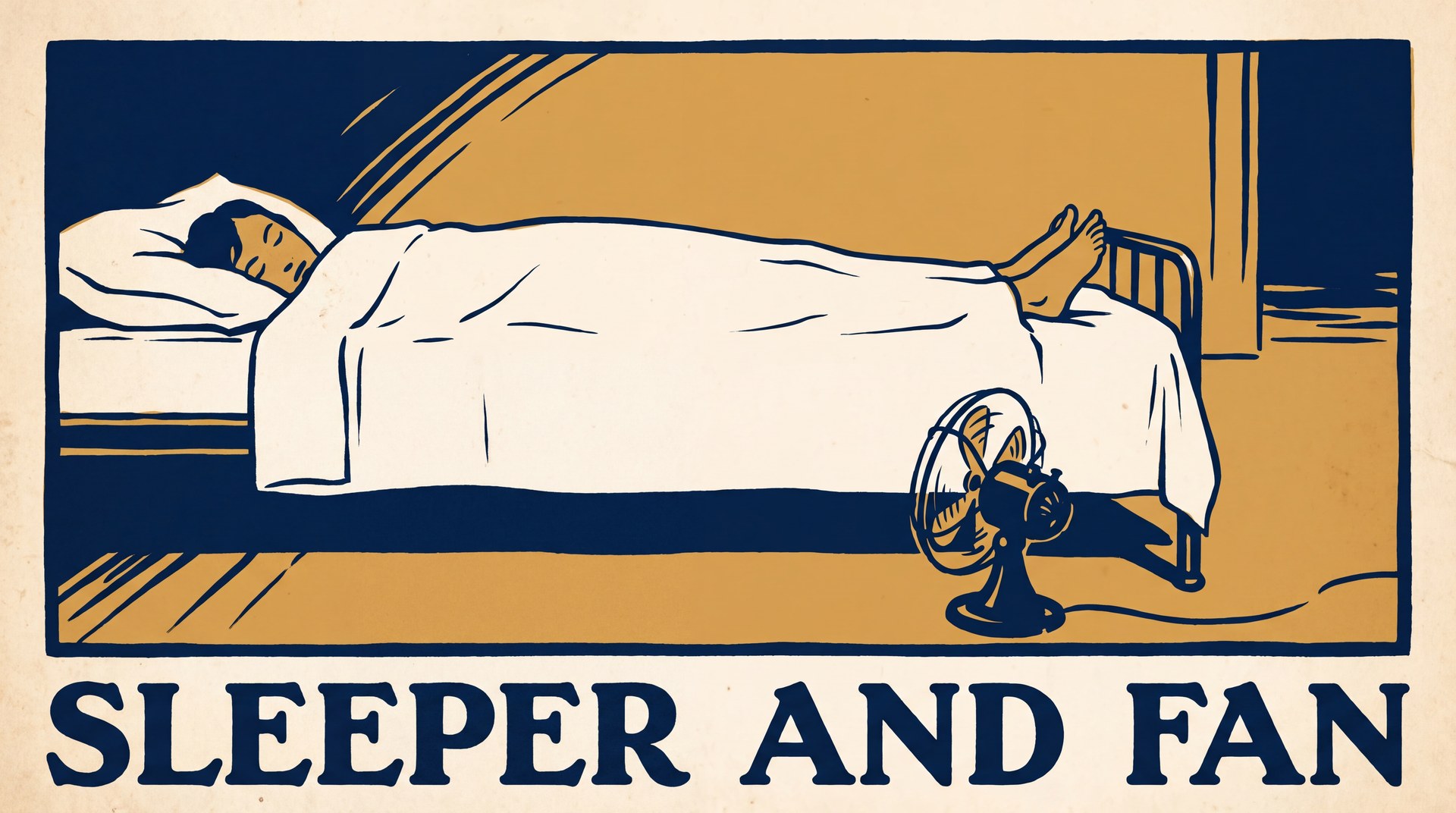
Yes, if you cannot cool the room any other way. A sleep psychologist quoted by Peloton suggests fans when you lack air conditioning. The steady hum also masks noise, which our white noise guide covers.
Why are my feet cold when the rest of me feels hot?
Cold feet mean the blood vessels in them have narrowed, so heat stays trapped in the core. Socks or a warm footbath open those vessels, which is why the socks study found faster sleep without a warmer core.
Sources
Night Air's reading for this piece, in the order it is cited, each with the question it helped answer.
- smart bed skin temperature study (ncbi.nlm.nih.gov), helped answer “Key Takeaways”; “Which way does the body's temperature move through the night?”; “How does the gap between skin and room air set the pace of the dip?”.
- study of younger and older women (pmc.ncbi.nlm.nih.gov), helped answer “Which way does the body's temperature move through the night?”.
- Okamoto-Mizuno and Mizuno, 2012 (ncbi.nlm.nih.gov), helped answer “How does the gap between skin and room air set the pace of the dip?”; “What do a cold room and a warm room each do to the dip?”; “Why can a room or bed stall the dip in the middle of the night?”.
- Cleveland Clinic (health.clevelandclinic.org), helped answer “How well does the common 60 to 67 degree advice fit the dip?”; “Common questions”.
- Hebrew SeniorLife (hebrewseniorlife.org), helped answer “Key Takeaways”; “Why might an older body need a warmer room for the same dip?”; “How can you start the dip before the room takes over?”.
- Kräuchi et al., 2000 (journals.physiology.org), helped answer “Key Takeaways”; “Why do your hands and feet get warm as you fall asleep?”.
- UT Austin (news.utexas.edu), helped answer “Key Takeaways”; “How can you start the dip before the room takes over?”.
- Scientific Reports, 2019 (nature.com), helped answer “Which way does the body's temperature move through the night?”.
- Sleep Foundation (sleepfoundation.org), helped answer “Which way does the body's temperature move through the night?”; “How well does the common 60 to 67 degree advice fit the dip?”; “Common questions”.
- Ko and Lee, 2018 (ncbi.nlm.nih.gov), helped answer “Why do your hands and feet get warm as you fall asleep?”; “How can you start the dip before the room takes over?”.
- Ko and Lee, 2018 (link.springer.com), helped answer “Why do your hands and feet get warm as you fall asleep?”.
- Harding et al., 2019 (pmc.ncbi.nlm.nih.gov), helped answer “How does the gap between skin and room air set the pace of the dip?”.
- Okamoto-Mizuno and Mizuno, 2024 (pmc.ncbi.nlm.nih.gov), helped answer “How does the gap between skin and room air set the pace of the dip?”.
- Angi (angi.com), helped answer “How well does the common 60 to 67 degree advice fit the dip?”.
- Sleep.com (sleep.com), helped answer “How well does the common 60 to 67 degree advice fit the dip?”.
- One Hour Heating & Air (onehourheatandair.com), helped answer “How well does the common 60 to 67 degree advice fit the dip?”.
- American Standard (americanstandardair.com), helped answer “How well does the common 60 to 67 degree advice fit the dip?”.
- Sleep Advisor (sleepadvisor.org), helped answer “How well does the common 60 to 67 degree advice fit the dip?”.
- Superpower (superpower.com), helped answer “How well does the common 60 to 67 degree advice fit the dip?”.
- GoodRx (goodrx.com), helped answer “How well does the common 60 to 67 degree advice fit the dip?”.
- Peloton (onepeloton.com), helped answer “How well does the common 60 to 67 degree advice fit the dip?”; “Common questions”.
- John Fawkes (johnfawkes.substack.com), helped answer “How well does the common 60 to 67 degree advice fit the dip?”.
- No Sleepless Nights (nosleeplessnights.com), helped answer “How well does the common 60 to 67 degree advice fit the dip?”.
- Minor et al., 2022 (orbit.dtu.dk), helped answer “What do a cold room and a warm room each do to the dip?”.
- Gulf News (gulfnews.com), helped answer “What do a cold room and a warm room each do to the dip?”.
- Scientific Reports, 2024 (nature.com), helped answer “What do a cold room and a warm room each do to the dip?”; “Why can a room or bed stall the dip in the middle of the night?”; “How can you start the dip before the room takes over?”.
- Mather Institute (matherinstitute.com), helped answer “Why might an older body need a warmer room for the same dip?”.
- study of younger and older women (ncbi.nlm.nih.gov), helped answer “Why might an older body need a warmer room for the same dip?”.
- ScienceDaily, 2022 (sciencedaily.com), helped answer “Why might an older body need a warmer room for the same dip?”.
- menstrual cycle study (ncbi.nlm.nih.gov), helped answer “Why can a room or bed stall the dip in the middle of the night?”.
- Sleep Foundation (sleepfoundation.org), helped answer “How can you start the dip before the room takes over?”.
- CNN, 2019 (cnn.com), helped answer “How can you start the dip before the room takes over?”; “Common questions”.