The short answer
Most published adult figures sit between 60 and 68°F, and the Sleep Foundation names about 65°F as a single setting (Sleep Foundation). Cleveland Clinic treats a bedroom below 60°F as too cold (Cleveland Clinic). For people 65 and older, a Boston home study found the most restful sleep at 68 to 77°F (Hebrew SeniorLife), and the National Institute on Aging says to heat the home to at least 68°F (NIA). The NHS puts a baby's room at 16 to 20°C (NHS).
This guide is for: people setting a thermostat at night, sharing a bedroom, looking after an older relative, or putting a baby down in a nursery.
Key Takeaways
Three numbers cover most bedrooms: a range for adults, a warmer band for people over 65, and a separate, fixed band for babies' rooms.
- Adults: 60 to 68°F. Every general adult figure on the health pages we counted fell inside this band. The Sleep Foundation says experts typically recommend 60 to 68°F. Its main guide says most doctors favor a thermostat set between 65 and 68°F (Sleep Foundation).
- Older adults: 68 to 77°F may suit. A Boston study of 50 older adults found sleep was most efficient and restful in that range. Sleep efficiency fell 5 to 10% as rooms warmed from 77 to 86°F (EurekAlert).
- Babies: 16 to 20°C. That is roughly sixty-one to sixty-eight degrees Fahrenheit. The NHS says this range is ideal for the room a baby sleeps in, because overheating can increase the risk of SIDS (NHS).
Each figure above is the range a named source states. The sections below show where each number comes from and who it applies to, so each reader can match the advice to a real bedroom.
What bedroom temperature do health agencies and hospitals publish?
Seven of the nine health pages we read gave a general adult figure, and every one of those figures fell between 60 and 68°F.
We read nine health and sleep-information pages on September 26, 2026, and counted the bedroom temperature each one states. We picked pages from hospitals, health services, research groups and sleep-information sites. Our method page explains how the counting works. The nine fell into three buckets:
- Five pages set the adult low end at 60°F. Four stop at 67°F and one goes to 68°F.
- Two pages center on 65°F. One gives 65 to 68°F and the other gives a single figure.
- Two pages give a range for one group only. One covers babies and one covers older adults.
| Page | Figure it states | Bucket |
|---|---|---|
| Cleveland Clinic | 60 to 67°F for adults | Low end at 60°F |
| GoodRx | 60 to 67°F | Low end at 60°F |
| Psychology Today | 60 to 67°F | Low end at 60°F |
| Ubie Health | 60 to 67°F | Low end at 60°F |
| Sleep Foundation news | 60 to 68°F | Low end at 60°F |
| Sleep Foundation guide | About 65°F, within 65 to 68°F | Centered on 65°F |
| Empower Sleep | Around 65°F for adults under 65 | Centered on 65°F |
| NHS | 16 to 20°C, babies only | One group only |
| Hebrew SeniorLife | 68 to 77°F, older adults only | One group only |
The pages agree that a cool room helps far more than they agree on one number. The whole adult spread is 8 degrees, from 60 to 68°F. If you already sleep well inside that band, these pages give you no reason to change the dial.
Why do sleep studies point to a cool room rather than a warm one?
Sleep starts as the body sheds heat through the hands and feet, and a cool room gives that heat somewhere to go, so studies lean cool.
Sleep and body heat run on the same daily clock. A 2019 review in Frontiers in Neuroscience looked at mammals active by day and by night. In both groups, sleep onset and a fall in core temperature occur together (Harding et al., 2019). That heat leaves mostly through the skin of the hands and feet, and the room air is where it goes. Our piece on how the room's temperature works against your body's overnight dip follows the body's side of that exchange.
A warm room slows the exchange. A very cold one can disrupt sleep in a different way. Heat and cold both push sleep the wrong way. A review in the Journal of Physiological Anthropology found that both raise wakefulness and cut rapid eye movement (REM) sleep and slow wave sleep (Okamoto-Mizuno and Mizuno, 2012). Slow wave sleep is the deepest stage of the night, and REM is the stage most tied to dreaming.
Temperature is one of three room conditions that sleep advice keeps coming back to. Cleveland Clinic's sleep psychologist Michelle Drerup compares the bedroom to a cave. She says it "should be cool, dark and quiet to enhance your sleep" (Cleveland Clinic). Darkness is the second of those conditions, and our guide on keeping a bedroom dark with curtains or shades covers it.
How cold can a bedroom get before the research counts it against sleep?
Under warm covers, a cool room rarely changes sleep stages. The published floor for healthy adults is 60°F, and it sits higher for frail people.
What matters is what sits between the sleeper and the air. In semi-nude subjects, cold exposure affects sleep stages more than heat does. Once people have covers, cold exposure does not affect sleep stages, though bedding and clothing are critical (Okamoto-Mizuno and Mizuno, 2012). A cool room with warm covers is the arrangement the research supports.
Cold still has costs. The same review found that cold changes the heart's automatic responses during sleep, even when sleep stages hold steady. Cleveland Clinic's Michelle Drerup is direct about the floor: a bedroom below 60°F is too cold. In the cold, she adds, blood vessels tighten and breathing becomes shallow, which puts extra strain on the heart (Cleveland Clinic).
Cold hands and feet are a sign the room is too cool for that sleeper. Clinical studies have linked cold extremities caused by narrowed blood vessels with poor sleep quality (PubMed Central). A smart-bed study reports that warming the feet raised skin temperature at the extremities and shortened the time it took to fall asleep (PMC smart-bed study). A pair of loose socks does that for you without warming the room.
If you look after an older or frail sleeper, the floor rises, and the section on older adults below gives the agency figure.
How hot is too hot for a bedroom at night?
Most adult guidance we counted tops out at 68°F, and humid heat makes a warm room worse because sweat cools the body less well.
No general adult figure in our count went above 68°F, and the Sleep Foundation's guide also stops its range there (Sleep Foundation). GoodRx quotes a sleep expert who names a bedroom that is too warm, or a blanket that is too heavy, as a common reason people wake at night (GoodRx).
Heat is also the more common problem in real bedrooms. With bedding and clothing in use, heat exposure increases wakefulness and cuts deep and REM sleep, and humid heat adds more strain (Okamoto-Mizuno and Mizuno, 2012).
The effect shows up across whole populations. A study of 765,000 US survey respondents linked warm nights to more reports of insufficient sleep. Each rise of 1 degree Celsius above normal meant about three more such nights per 100 people per month (University of California).
The table below is our judgement, built from the seven general adult figures in our count. It is not the finding of any single study.
| Bedroom at night | Adult figures that include it | Our reading |
|---|---|---|
| Below 60°F (16°C) | 0 of 7 | Too cold unless bedding is heavy |
| 60 to 64°F (16 to 18°C) | 5 of 7 | Suits most adults under warm covers |
| 65°F (18°C) | 7 of 7 | The only setting every figure includes |
| 66 to 67°F (19°C) | 6 of 7 | A safe middle for most bedrooms |
| 68°F (20°C) | 2 of 7 | Warm end; watch for night waking |
| Above 68°F (20°C) | 0 of 7 | Warm for most adults; older adults may differ |
What room temperature do studies and agencies give for older adults?
A Boston home study found the most efficient sleep at 68 to 77°F, and the National Institute on Aging sets a heating floor of 68°F.
Most familiar advice was not built around older sleepers, and one long study suggests it may run cold for them. A researcher at Hebrew SeniorLife's Marcus Institute for Aging Research monitored sleep and bedroom temperature in 50 older adults for nearly 18 months, using wearable sleep monitors and room sensors (Hebrew SeniorLife blog).
Across nearly 11,000 person-nights, sleep was most efficient and restful at 68 to 77°F. Sleep efficiency dropped 5 to 10% as rooms warmed from 77 to 86°F (EurekAlert). The authors also found large differences between people (Hebrew SeniorLife), so the range works as a starting point.
The federal floor points the same way. The National Institute on Aging says to set the heat to at least 68°F and warns that homes at 60 to 65°F can lead to hypothermia in older adults (National Institute on Aging). That puts the lower half of the common adult band inside the agency's risk zone for this group. For cold nights it advises extra covers and long underwear under pajamas.
Heat is the other risk at that age. Hebrew SeniorLife suggests light, breathable linens and blackout curtains to keep a bedroom cool in summer (Hebrew SeniorLife).
What temperature should a baby's room be?
The NHS in Britain puts a baby's room at 16 to 20°C, roughly sixty-one to sixty-eight degrees Fahrenheit, because overheating raises SIDS risk.
US and UK sources put the number in slightly different places, so it helps to know which one you are reading. The NHS says all-night heating is rarely necessary and about 16 to 20°C is ideal (NHS). That range works out to roughly sixty-one to sixty-eight degrees Fahrenheit. US pages run a little warmer. The Sleep Foundation says infants may benefit from a bedroom up to 69°F (Sleep Foundation). Cleveland Clinic puts the range for babies and toddlers a bit higher, at 65 to 70°F (Cleveland Clinic).
| Source | Figure it states | In Fahrenheit |
|---|---|---|
| NHS | 16 to 20°C | Roughly sixty-one to sixty-eight |
| Sleep Foundation | Up to 69°F | Up to 69°F |
| Cleveland Clinic | 65 to 70°F, babies and toddlers | 65 to 70°F |
All three agree that overheating is the danger. The NHS warns that babies can overheat from too much bedding or clothing, or from a room that is too hot. It advises you to check a baby's temperature by feeling the chest or the back of the neck. Cool hands or feet on your baby are nothing to worry about, it adds (NHS SIDS page).
How does bedding change which room temperature feels comfortable?
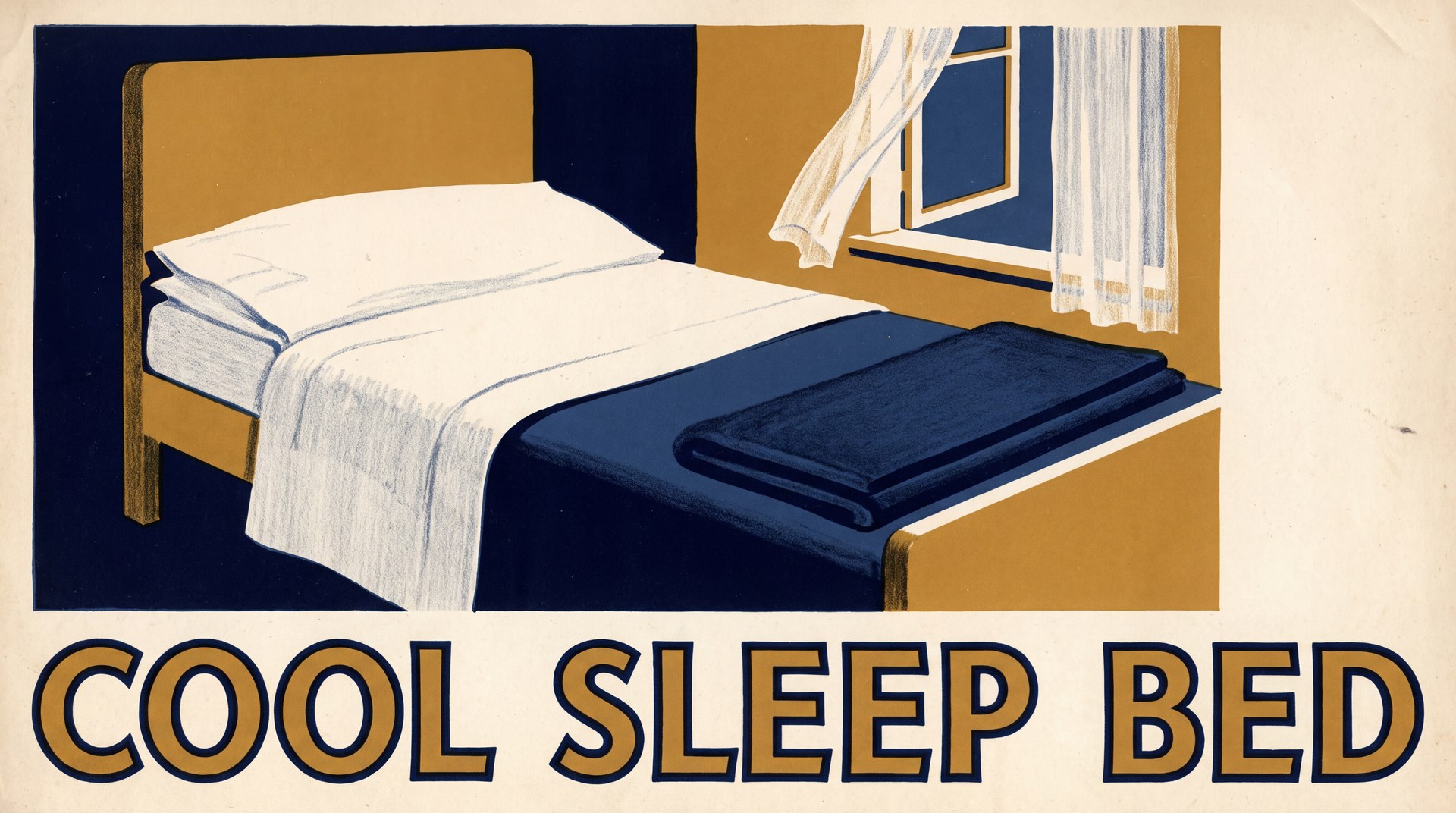
Covers set the air next to the skin, so a heavier duvet widens the range of room temperatures people find comfortable, mostly on the cold side.
Covers matter about as much as the thermostat. A study in the Journal of Thermal Biology, summarized by the Sleep Foundation, found that people with a thinner duvet needed the room at 62 to 72°F to feel comfortable. With a heavier duvet they slept comfortably from 46 to 64°F (Sleep Foundation, 2023). Sleep quality held up as long as the temperature inside the bed stayed at 86 to 91°F.
| Bed setup | Room range people found comfortable | Source |
|---|---|---|
| Thinner duvet | 62 to 72°F | Sleep Foundation, 2023 |
| Heavier duvet | 46 to 64°F | Sleep Foundation, 2023 |
| Temperature inside the bed | 86 to 91°F | Sleep Foundation, 2023 |
The common 65°F advice rests on an unstated assumption, which is an ordinary comforter. Under a single sheet in July, 65°F can feel chilly to you, and under a winter duvet it may feel about right. The 2012 review makes the same point, noting that how room temperature affects sleep stages depends on bedding and clothing (Okamoto-Mizuno and Mizuno, 2012).
If you and a partner disagree about temperature, you will usually do better by splitting the covers than by arguing over the thermostat. With two duvets of different weights on one bed, each person sets the air under their own covers while the room stays in a range both can live with.
How do you hold a bedroom at the published range through the night?
Set the thermostat a few degrees lower at night, choose lighter bedding in summer, and try a warm bath one to two hours before bed.
Start with your room, then your bed, then your body. The Sleep Foundation advises reducing heat build-up during the day, turning down the thermostat at night, and choosing cooling bedding (Sleep Foundation). Cleveland Clinic suggests keeping a fan in the room so cooling down is easy on warm nights (Cleveland Clinic). A fan also makes a steady sound, and our guide to white noise for sleep covers that side of it.
A warm bath sounds backward, but the evidence behind it is solid. A 2019 review from the University of Texas at Austin pooled earlier studies and found that a bath 1 to 2 hours before bedtime, in water of about 104 to 109°F, can improve sleep (UT Austin).
The table gives our starting points. They are judgements drawn from the sources above, and each is a place for you to begin before adjusting one degree at a time.
| Sleeper | Our starting point (judgement) | Based on |
|---|---|---|
| Healthy adult, ordinary comforter | 65°F | Sleep Foundation single figure |
| Adult under a heavy winter duvet | 62 to 64°F | Heavier-duvet range above |
| Adult under a sheet or thin blanket | 66 to 68°F | Thinner-duvet range above |
| Adult 65 or older | 68 to 72°F | National Institute on Aging heating floor |
| Infant | 66 to 68°F, light sleepwear | Cleveland Clinic range for babies |
Common questions
Short answers to the questions people ask most often about bedroom heat, from fans and socks to hot weather and couples sharing a bed.
Can a bedroom be too warm for sleep?
Yes. The Sleep Foundation's guide tops out at 68°F for most adults (Sleep Foundation). Older adults are the exception, since the Boston study found efficient sleep up to 77°F (Hebrew SeniorLife).
Is 60°F too cold to sleep?
It sits right at the bottom edge of the adult advice. Cleveland Clinic treats anything below 60°F as too cold (Cleveland Clinic). For older adults the National Institute on Aging warns that homes at 60 to 65°F can cause hypothermia (NIA).
Do socks help you fall asleep?
They can help, because warm hands and feet let heat leave your core. The smart-bed study notes that warming the feet raised skin temperature and shortened the time it took to fall asleep (PMC).
Does a fan help you sleep in a warm room?
It can. Cleveland Clinic suggests keeping a fan in the bedroom so cooling down is easy when you feel too warm (Cleveland Clinic). The steady sound may help you sleep as well.
What should couples do when they want different temperatures?
Set the room to suit the person who runs warmer, then let the cooler partner add a heavier blanket on their side. Adding a layer is easier than cooling a body, so this split usually works better than meeting in the middle.
Does hot weather make people lose sleep?
Yes. A Science Advances study of 765,000 US survey respondents linked warmer-than-normal nights to more reports of insufficient sleep (University of California).
The room check sends answers like these to the room stays too warm overnight, and a thermometer at the pillow will show it or nothing in the room may be the problem.
Sources
Night Air's reading for this piece, in the order it is cited, each with the question it helped answer.
- Sleep Foundation (sleepfoundation.org), helped answer “Key Takeaways”; “What bedroom temperature do health agencies and hospitals publish?”; “How hot is too hot for a bedroom at night?”; “What temperature should a baby's room be?”; “How do you hold a bedroom at the published range through the night?”; “Common questions”.
- Cleveland Clinic (health.clevelandclinic.org), helped answer “What bedroom temperature do health agencies and hospitals publish?”; “Why do sleep studies point to a cool room rather than a warm one?”; “How cold can a bedroom get before the research counts it against sleep?”; “What temperature should a baby's room be?”; “How do you hold a bedroom at the published range through the night?”; “Common questions”.
- Hebrew SeniorLife (hebrewseniorlife.org), helped answer “What room temperature do studies and agencies give for older adults?”; “Common questions”.
- National Institute on Aging (nia.nih.gov), helped answer “What room temperature do studies and agencies give for older adults?”; “Common questions”.
- NHS (nhs.uk), helped answer “What bedroom temperature do health agencies and hospitals publish?”; “What temperature should a baby's room be?”.
- Sleep Foundation (sleepfoundation.org), helped answer “Key Takeaways”; “What bedroom temperature do health agencies and hospitals publish?”; “How does bedding change which room temperature feels comfortable?”.
- EurekAlert (eurekalert.org), helped answer “Key Takeaways”; “What room temperature do studies and agencies give for older adults?”.
- NHS SIDS page (nhs.uk), helped answer “Key Takeaways”; “What temperature should a baby's room be?”.
- GoodRx (goodrx.com), helped answer “What bedroom temperature do health agencies and hospitals publish?”; “How hot is too hot for a bedroom at night?”.
- Psychology Today (psychologytoday.com), helped answer “What bedroom temperature do health agencies and hospitals publish?”.
- Ubie Health (ubiehealth.com), helped answer “What bedroom temperature do health agencies and hospitals publish?”.
- Empower Sleep (empowersleep.com), helped answer “What bedroom temperature do health agencies and hospitals publish?”.
- Hebrew SeniorLife (hebrewseniorlife.org), helped answer “What bedroom temperature do health agencies and hospitals publish?”; “What room temperature do studies and agencies give for older adults?”.
- Harding et al., 2019 (frontiersin.org), helped answer “Why do sleep studies point to a cool room rather than a warm one?”.
- Okamoto-Mizuno and Mizuno, 2012 (ncbi.nlm.nih.gov), helped answer “Why do sleep studies point to a cool room rather than a warm one?”; “How cold can a bedroom get before the research counts it against sleep?”; “How hot is too hot for a bedroom at night?”; “How does bedding change which room temperature feels comfortable?”.
- PubMed Central (ncbi.nlm.nih.gov), helped answer “How cold can a bedroom get before the research counts it against sleep?”.
- PMC smart-bed study (ncbi.nlm.nih.gov), helped answer “How cold can a bedroom get before the research counts it against sleep?”; “Common questions”.
- University of California (universityofcalifornia.edu), helped answer “How hot is too hot for a bedroom at night?”; “Common questions”.
- Hebrew SeniorLife blog (hebrewseniorlife.org), helped answer “What room temperature do studies and agencies give for older adults?”.
- UT Austin (news.utexas.edu), helped answer “How do you hold a bedroom at the published range through the night?”.