How cold should your bedroom be when you sleep?
Updated .
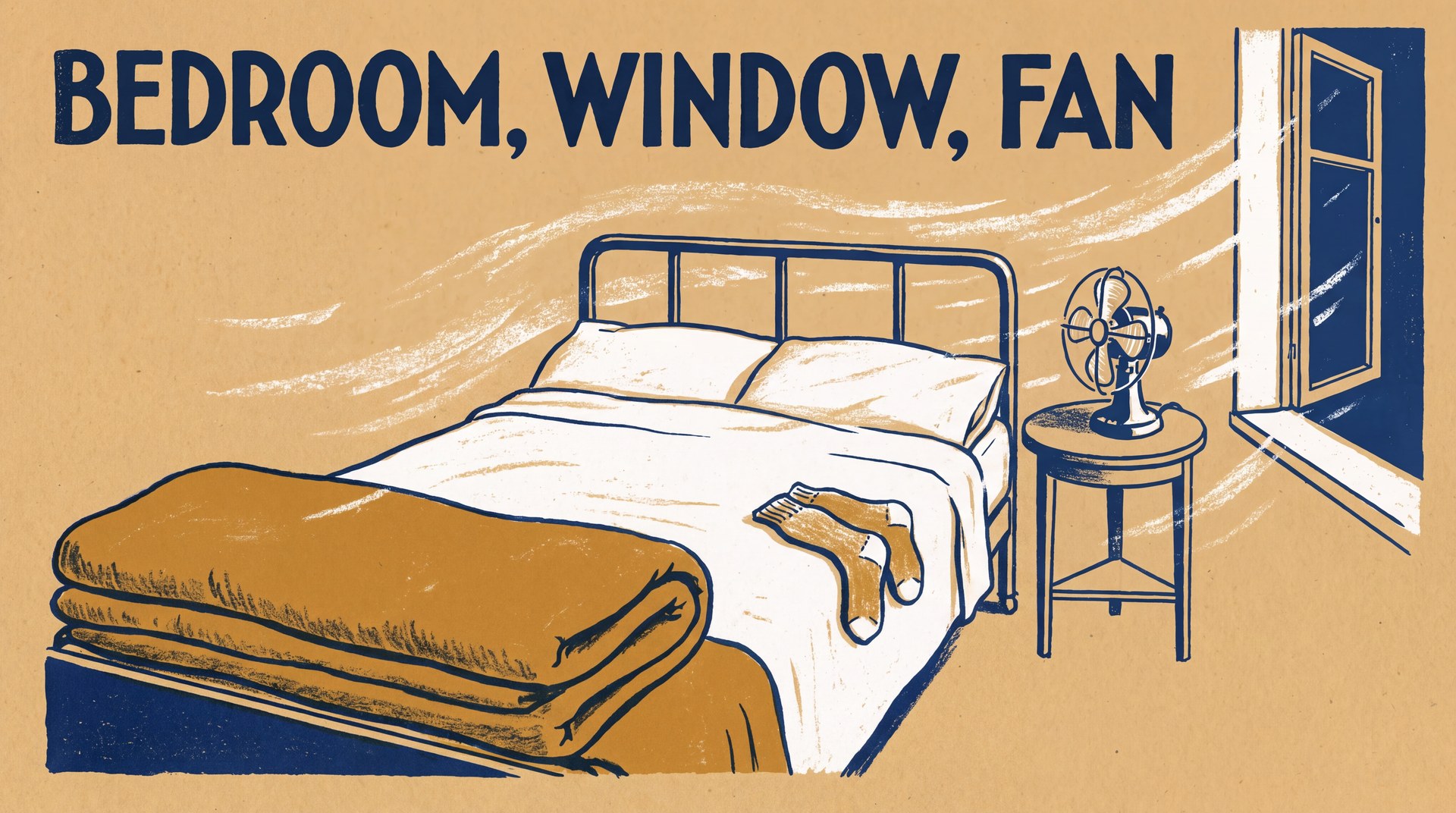
Ask a sleep clinic how cold a bedroom should be and the answer lands in the 60s. Cleveland Clinic's sleep psychologist advises 60 to 67°F (Cleveland Clinic, 2021), and the Sleep Foundation names 65°F as the best single setting (Sleep Foundation, 2025). Those numbers suit healthy adults sleeping under ordinary covers. They fit people over 65 far less well, and a colder room is not automatically a better one.
Short answer: Start at 65°F if you are a healthy adult under a comforter, then adjust a degree or two at a time over several nights. Stay within 60 to 68°F for most adults. If you are 65 or older, keep the room at 68°F or warmer. A Boston study found the best sleep in that age group at 68 to 77°F (Medical Xpress, 2023), and the National Institute on Aging warns that homes at 60 to 65°F can cause hypothermia (NIA).
This guide is for: healthy adults setting a thermostat at night, people who wake up hot or cold, and anyone looking after an older relative's bedroom.
Key Takeaways
Three findings carry most of the weight here: the common range, the reason cool rooms work, and the exception for older adults.
- 65°F is the most quoted starting point for healthy adults. It sits inside the 60 to 67°F band Cleveland Clinic gives (Cleveland Clinic, 2021) and the 65 to 68°F band the Sleep Foundation gives (Sleep Foundation, 2025). Treat it as a first setting to adjust from, since no single figure suits everyone.
- Core body temperature drops about 1.8°F at night (Sleep Foundation). A warm bath taken one to two hours before bed helps that fall along and got people to sleep about 10 minutes sooner on average (CNN, 2019).
- People 65 and older slept best at 68 to 77°F in a study that followed 50 adults in the Boston area over about 11,000 nights (TODAY, 2023). The cold-bedroom rule written for younger adults does not carry over to them.
On This Page
Each entry below is one question from this page, in the order it appears, so you can jump straight to the part you came to read.
The first three sections cover the numbers and the way the body cools itself at night. The middle three check the common advice against a count of published guides and against what older adults need. The last two are practical and deal with covers, pajamas, baths and airflow. The common questions at the end repeat the key figures in short form.
What is the ideal temperature to sleep in?
Most adult guidance lands between 60 and 68°F, with 65°F the figure quoted most often, and older adults do better a few degrees warmer.
The numbers from clinics and sleep groups sit close together. Cleveland Clinic advises 60 to 67°F (15 to 19°C) (Cleveland Clinic, 2021). The Sleep Foundation calls 65°F the best setting and says most doctors recommend 65 to 68°F (Sleep Foundation, 2025). A Sleep Foundation news report gives the usual expert range as 60 to 68°F (Sleep Foundation, 2023). Each source adds that personal preference moves the figure by a few degrees.
The research behind those numbers explains why the advice leans cool. A review in the Journal of Physiological Anthropology found that in real bedrooms, with bedding and clothing, heat does more visible damage to sleep than cold: it raises wakefulness and cuts both deep sleep and REM sleep (Okamoto-Mizuno and Mizuno, 2012). A room that runs a little cool can be fixed with one more blanket, while a room that runs hot is much harder to fix from inside the bed.
| Source | Who it covers | Range it gives |
|---|---|---|
| Cleveland Clinic | Adults | 60 to 67°F (15 to 19°C) |
| Sleep Foundation | Adults | 65 to 68°F, with 65°F as the single figure |
| Sleep Foundation | Infants | Up to 69°F (20.5°C) |
| Cleveland Clinic | Babies and toddlers | 65 to 70°F |
| Medical Xpress, 2023 | Adults 65 and older | 68 to 77°F |
| National Institute on Aging | Older adults, safety floor | At least 68°F |
Does your body temperature rise when you sleep?
No. Your core temperature falls by about 1.8°F at night, while your hands and feet warm up as they push heat out of your body.
Core temperature goes down, and the drop starts before bedtime. Body temperature runs 2 to 3°F higher in the late afternoon and early evening than during sleep, when it reaches its daily low (ScienceDaily, 2019). The Sleep Foundation puts the nightly drop at around 1.8°F (Sleep Foundation), and the National Sleep Foundation describes a fall of roughly one to two degrees Fahrenheit as part of falling asleep (National Sleep Foundation).
So the answer depends on where the thermometer sits. Your hands and feet do get warmer. As you pass from waking into sleep, skin on the hands and feet rises by about 1°C, a little under two degrees Fahrenheit, and skin on the belly and chest rises by about 0.5°C, just under one degree Fahrenheit. Those figures come from the research summary in a study that estimated skin temperature from sensors built into a bed (PubMed Central). The warming happens because blood vessels near the surface open up to release heat, and that is how the core cools.
The vessels start opening up to 2 hours before the first stretch of sleep, while people are still awake (Frontiers in Neuroscience, 2019). Toward morning the curve turns around, and core temperature begins to rise about two hours before you wake (Sleepstation).
Why does a cool room help you fall asleep faster?
Sleep tends to start while core temperature is dropping, and a cool room lets your skin shed heat quickly enough to keep that drop going.
The body seems to choose its moment. In experiments where people picked their own bedtime, most chose the point when body temperature was falling fastest, and the steepest drops in core temperature and heart rate coincide with lights-off (Frontiers in Neuroscience, 2019). The temperature gap between the hands and feet and the trunk is one of the better predictors of how quickly sleep arrives (Scientific Reports, 2020).
A cool room helps because the heat leaving the skin has somewhere to go. In a warm room, skin sheds heat more slowly and the core stays warm longer. The same logic explains why a warm bath can speed sleep rather than delay it. Engineers at the University of Texas at Austin pooled the research and found that bathing 1 to 2 hours before bed in water of about 104 to 109°F improved sleep (UT Austin, 2019). The team narrowed 5,322 studies down to 17, and people who bathed fell asleep about 10 minutes sooner on average (CNN, 2019).
Timing matters. The lead author said a bath 15 minutes before bed came too late to give the same effect, and that a cold shower works the other way by making the body warm itself up (CNN, 2019). If you like to sleep in a cold room, a warm bath earlier in the evening fits the evidence better than a cold rinse at bedtime.
What bedroom temperature do most sleep guides recommend?
Of the 15 guide pages counted here, most cap the adult range at 67°F, a smaller group stops at 68°F, and two give something else.
We read 15 web pages on September 26, 2026. Each one came up in searches for the best temperature for sleep and states a bedroom range for adults. For each page we noted the top of the adult range it gives as its main advice, then sorted the pages into three groups. This is a count of what the pages say and nothing was measured. The rules we follow for counts are on our method page.
| Group | Pages | Share of 15 |
|---|---|---|
| Top of adult range at 67°F | 10 | 67% |
| Top of adult range at 68°F | 3 | 20% |
| Some other answer | 2 | 13% |
Ten pages stop at 67°F. Eight of them give 60 to 67°F, the range Cleveland Clinic uses (Cleveland Clinic, 2021), and two start a little higher, at 62°F or 63°F. Three pages stop at 68°F, including the Sleep Foundation's 65 to 68°F guide (Sleep Foundation, 2025) and its 60 to 68°F news report (Sleep Foundation, 2023). Of the last two, one mattress seller gives 60 to 72°F (Amerisleep), and one bedding seller gives both 60 to 67°F and 65 to 68°F on the same page (Or & Zon).
The count shows how firmly the web has settled on a ceiling of 67 or 68°F. None of the studies cited in this guide treats either number as a cut-off. The one large study of older adults found their best range extended well above both.
How cold is too cold to sleep in?
Under covers, a cool room rarely alters sleep stages, but a cold room still changes heart activity, and 60 to 65°F can be risky for frail people.
Healthy adults have no agreed lower limit, because covers do most of the work. The 2012 review found that with bedding and clothing, cold exposure did not change sleep stages. It did change the heart's automatic activity during sleep, though, and the authors suggested that in real life cold may have more impact than heat (Okamoto-Mizuno and Mizuno, 2012). People sleeping with very little on were disturbed more by cold than by heat.
Cold hands and feet are a warning sign worth taking seriously. Clinical studies have linked cold extremities caused by narrowed blood vessels with poor sleep quality (PubMed Central). If your feet stay cold long after you get into bed, the room or the bedding is too cool for you, whatever the thermostat reads.
The floor is firmer for older and frail people. The National Institute on Aging says to set the heat to at least 68°F and warns that homes at 60 to 65°F can lead to hypothermia in older adults (National Institute on Aging). The agency defines the danger point as a core temperature of 95°F or lower (National Institute on Aging, 2022). That puts the lower half of the popular 60 to 67°F band (Cleveland Clinic, 2021) inside the agency's risk zone for this group. For cold nights it recommends a warm bed rather than a cold one: extra covers, long underwear under pajamas, and something to cover the head.
Should older adults keep the bedroom warmer at night?
Yes. A Boston study of people 65 and older found the best sleep at 68 to 77°F, and a federal agency says to keep heat at 68°F or above.
The evidence so far points that way. Researchers at the Marcus Institute for Aging Research and Harvard Medical School followed older adults in their own homes using wearable sleep monitors and room sensors. They found that sleep was most efficient and restful at 68 to 77°F (Medical Xpress, 2023). Sleep efficiency fell by 5 to 10% as the room warmed from 77°F to 86°F, and the best temperature varied widely from one person to the next.
The sample was 50 adults aged 65 and older in the Boston area, followed for a year and about 11,000 nights (TODAY, 2023). A sleep physician quoted in the same report linked the result to the body regulating its own temperature less well with age. That matches the federal advice on cold homes. It also means the 60 to 67°F rule is a poor default for someone well into old age.
Warm nights are a problem too, and older people carry more of it. A global analysis estimated that people are already losing about 44 hours of sleep a year to higher temperatures (Euronews). The loss was larger in older adults and in women, and it could reach 50 to 58 hours a year by 2099 (ScienceDaily, 2022). The practical band for an older relative is warm enough to stay safe from cold and cool enough to avoid the hot nights the Boston study linked to poorer sleep.
How do blankets change the ideal sleep temperature?
Covers set the air next to your skin, so a heavier duvet widens the range of room temperatures people find comfortable, mostly on the cold side.
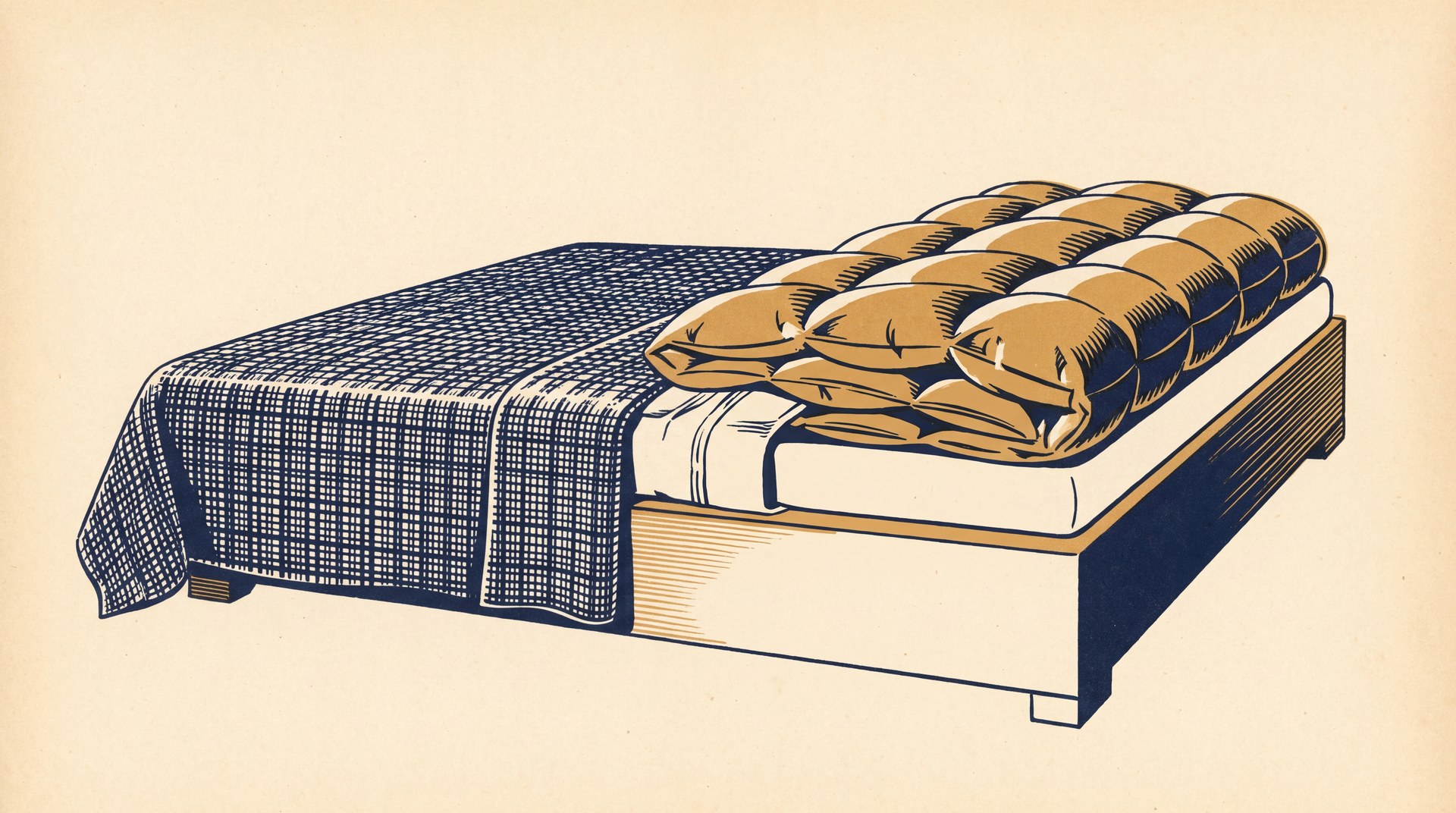
Covers matter about as much as the thermostat. A study in the Journal of Thermal Biology, summarized by the Sleep Foundation, found that people with a thinner duvet needed the room at 62 to 72°F to feel comfortable. With a heavier duvet they slept comfortably from 46 to 64°F (Sleep Foundation, 2023). Sleep quality held up as long as the temperature inside the bed stayed at 86 to 91°F.
| Bed setup | Room range people found comfortable | Source |
|---|---|---|
| Thinner duvet | 62 to 72°F | Sleep Foundation, 2023 |
| Heavier duvet | 46 to 64°F | Sleep Foundation, 2023 |
| Temperature inside the bed | 86 to 91°F | Sleep Foundation, 2023 |
The 65°F advice rests on an unstated assumption: an ordinary comforter. Under a single sheet in July, 65°F can feel chilly, and under a winter duvet it may feel about right. The 2012 review makes the same point, noting that how room temperature affects sleep stages depends on bedding and clothing. It adds that humid heat raises the heat load on a sleeping body even further (Okamoto-Mizuno and Mizuno, 2012).
Couples who disagree about temperature usually do better by splitting the covers than by arguing over the thermostat. With two duvets of different weights on one bed, each person controls the air under their own covers while the room stays in a range both can live with.
How can you cool a bedroom for sleep without freezing?
Cool the room before bed, dress the bed for the season, and take a warm bath an hour or two ahead so your body sheds heat on its own.
Work from the room inward. Let the thermostat start dropping well before bed, and keep sun-facing windows covered through the afternoon; our guide to blackout shades for a bedroom covers which ones keep a room dark. If light also wakes you, blackout curtains for a bedroom are the other option. A fan moving air across the bed helps skin lose heat, and our guide on setting up white noise for sleep covers using its steady hum to mask other sounds.
The table gives our starting points. They are judgements drawn from the sources in this guide rather than measurements, and each one is a place to begin before adjusting one degree at a time.
| Sleeper | Our starting point (judgement) | Based on |
|---|---|---|
| Healthy adult, ordinary comforter | 65°F | Sleep Foundation single figure, cited above |
| Adult under a heavy winter duvet | 62 to 64°F | Heavier-duvet range in the bedding table above |
| Adult under a sheet or thin blanket | 66 to 68°F | Thinner-duvet range in the bedding table above |
| Adult 65 or older | 68 to 72°F | National Institute on Aging heating floor, cited above |
| Infant | 66 to 68°F, light sleepwear | Cleveland Clinic range for babies, cited above |
Then warm the body before bed so it can cool itself. Take a bath at about 104 to 109°F one to two hours ahead (UT Austin, 2019), and wear socks if your feet run cold, since warming the feet has been shown to shorten the time it takes to fall asleep (PubMed Central).
Common questions
Short answers to the questions people ask most about sleeping cool, from socks and baths to babies, each backed by a source above.
Is it healthier to sleep in a cold room?
Cool, yes; cold, not always. Under covers, heat disrupts sleep stages more than cool air does (Okamoto-Mizuno and Mizuno, 2012), but homes at 60 to 65°F can cause hypothermia in older adults (NIA).
Do socks help you fall asleep?
They can. Warming the feet raises skin temperature at the extremities, which is how the body releases heat, and it has been shown to shorten the time people take to fall asleep (PubMed Central).
Does a hot shower work as well as a bath?
The UT Austin analysis grouped warm showers and baths together as passive body heating. The best results came from water at about 104 to 109°F, used 1 to 2 hours before bed (UT Austin, 2019).
What temperature is too hot to sleep in?
Most guides top out at 67°F (Cleveland Clinic, 2021) or 68°F (Sleep Foundation, 2025) for adults. In people 65 and older, sleep efficiency fell 5 to 10% as the room warmed from 77°F to 86°F (Medical Xpress, 2023).
What temperature should a baby's room be?
The Sleep Foundation suggests up to 69°F and says a room that is too warm may raise the risk of SIDS (Sleep Foundation, 2025). Cleveland Clinic gives 65 to 70°F and suggests feeling the back of the neck or the stomach to check for overheating (Cleveland Clinic, 2021).
Are warmer nights costing people sleep?
Yes. One global analysis found the average person is already losing 44 hours of sleep a year to warmer nights, which adds up to 11 nights with less than seven hours of sleep (Mother Jones, 2022).
Sources
Night Air's reading for this piece, in the order it is cited, each with the question it helped answer.
- Cleveland Clinic, 2021 (health.clevelandclinic.org), helped answer “Key Takeaways”; “What is the ideal temperature to sleep in?”; “What bedroom temperature do most sleep guides recommend?”; “How cold is too cold to sleep in?”; “Common questions”.
- Sleep Foundation, 2025 (sleepfoundation.org), helped answer “Key Takeaways”; “What is the ideal temperature to sleep in?”; “What bedroom temperature do most sleep guides recommend?”; “Common questions”.
- Medical Xpress, 2023 (medicalxpress.com), helped answer “What is the ideal temperature to sleep in?”; “Should older adults keep the bedroom warmer at night?”; “Common questions”.
- National Institute on Aging (nia.nih.gov), helped answer “What is the ideal temperature to sleep in?”; “How cold is too cold to sleep in?”; “Common questions”.
- Sleep Foundation (sleepfoundation.org), helped answer “Key Takeaways”; “Does your body temperature rise when you sleep?”.
- CNN, 2019 (cnn.com), helped answer “Key Takeaways”; “Why does a cool room help you fall asleep faster?”.
- TODAY, 2023 (today.com), helped answer “Key Takeaways”; “Should older adults keep the bedroom warmer at night?”.
- Sleep Foundation, 2023 (sleepfoundation.org), helped answer “What is the ideal temperature to sleep in?”; “What bedroom temperature do most sleep guides recommend?”; “How do blankets change the ideal sleep temperature?”.
- Okamoto-Mizuno and Mizuno, 2012 (ncbi.nlm.nih.gov), helped answer “What is the ideal temperature to sleep in?”; “How cold is too cold to sleep in?”; “How do blankets change the ideal sleep temperature?”; “Common questions”.
- ScienceDaily, 2019 (sciencedaily.com), helped answer “Does your body temperature rise when you sleep?”.
- National Sleep Foundation (thensf.org), helped answer “Does your body temperature rise when you sleep?”.
- PubMed Central (ncbi.nlm.nih.gov), helped answer “Does your body temperature rise when you sleep?”; “How can you cool a bedroom for sleep without freezing?”; “Common questions”.
- Frontiers in Neuroscience, 2019 (frontiersin.org), helped answer “Does your body temperature rise when you sleep?”; “Why does a cool room help you fall asleep faster?”.
- Sleepstation (sleepstation.org.uk), helped answer “Does your body temperature rise when you sleep?”.
- Scientific Reports, 2020 (nature.com), helped answer “Why does a cool room help you fall asleep faster?”.
- UT Austin, 2019 (news.utexas.edu), helped answer “Why does a cool room help you fall asleep faster?”; “How can you cool a bedroom for sleep without freezing?”; “Common questions”.
- Amerisleep (amerisleep.com), helped answer “What bedroom temperature do most sleep guides recommend?”.
- Or & Zon (orezon.co), helped answer “What bedroom temperature do most sleep guides recommend?”.
- PubMed Central (ncbi.nlm.nih.gov), helped answer “How cold is too cold to sleep in?”.
- National Institute on Aging, 2022 (nia.nih.gov), helped answer “How cold is too cold to sleep in?”.
- Euronews (euronews.com), helped answer “Should older adults keep the bedroom warmer at night?”.
- ScienceDaily, 2022 (sciencedaily.com), helped answer “Should older adults keep the bedroom warmer at night?”.
- Mother Jones, 2022 (motherjones.com), helped answer “Common questions”.